
You have a list of buildings and nobody is calling them. You tried the phones for two weeks, got hung up on, and wrote off cold calling. It still works: one dedicated dialer at about 1,000 calls a month books 8 to 15 walkthroughs and signs 2 to 4 contracts, which is what we see when cleaning companies log their dials honestly. Below are the five ways to book those walkthroughs compared on cost, the script word for word, six objection lines, the volume math, and a straight answer on when to stop dialing yourself.
Five ways to book a walkthrough, compared on cost
| Approach | How you pay | Cost per booked walkthrough | Best for | Weakest fit |
|---|---|---|---|---|
| You dial it yourself | Your own time, 8 to 12 hours a week | $0 cash | Under $500k and needing pipeline this quarter | Owners already buried in crew problems |
| In-house appointment setter | Hourly plus a bonus per held meeting | $150 to $400 once trained | $750k and up, with someone who coaches the role weekly | No script, no list, no manager |
| Offshore or virtual setter | $8 to $15 an hour | $100 to $300 when it works | Big simple lists and a generic office pitch | Medical, schools, anything needing local credibility |
| Telemarketing call center on retainer | $1,500 to $5,000 a month | $200 to $600 | Volume without hiring or managing anyone | Loose qualification and meetings nobody agreed to |
| Pay-per-lead outbound (Zotex Media) | $200 flat per walkthrough-ready lead | $200 | Owners who close well and hate prospecting | Companies with no crew capacity for new work |
Those cost-per-walkthrough figures are the ranges owners report back after they shop these options and track a full quarter. All five live or die on the same three things: the list, the opener, and whether the ask names a day and a time.
The honest headline is that the models converge on cash. A well-run in-house dialing seat and flat-rate outbound land within a few dollars of each other per meeting. What separates them is ramp time, management load, and whether the flow is still there in month four.
What each model costs and how long it takes to ramp
| Model | Typical cost | Ramp to first walkthrough | Who controls quality | Main risk |
|---|---|---|---|---|
| DIY dialing | 8 to 12 hours a week of owner time | 1 to 2 weeks | You | You stop the week you get busy |
| In-house setter | $18 to $26 an hour loaded, plus $100 to $200 a month in data and dialer | 4 to 10 weeks | You, through weekly call reviews | Turnover resets you to zero |
| Retainer call center | $1,500 to $5,000 a month | 3 to 6 weeks | Them | You pay whether it works or not |
| Pay-per-appointment | $150 to $400 per appointment | 2 to 5 weeks | Split, and that is the problem | Calendar slots where nobody agreed to anything |
| Pay-per-lead | $200 flat per qualified lead | 2 to 4 weeks | Them, with a replacement policy | Leads outrun your crew capacity |
The loaded hourly range above is what clients pay in most metros once payroll taxes are in. Sanity check your own area against the BLS wage data for telemarketing and inside sales roles, then build your number from your payroll, not a job board.
If you want this math run against your own close rate before you hire anyone, that is what a free strategy call is for, and the flat-rate side is spelled out on the pricing page.
Each option, and what it costs you besides money
You dial it yourself
Best for: owners under roughly $500k who can price a job on the spot. Pricing: free in cash, expensive in calendar. Why it is on the list: nobody books walkthroughs like the person who can answer the price question live. Owner dialing also teaches you which objections your market actually uses, and that becomes the script your setter reads later.
The trade-off is real. Owner dialing dies the first week you lose a supervisor. If you go this route, block two hours every weekday morning and treat it like a route you cannot skip.
In-house appointment setter
Best for: companies past $750k with a manager who will listen to recorded calls every week. Pricing: $18 to $26 an hour loaded plus data and dialer software. Why it is on the list: a setter who stays two years becomes the cheapest pipeline you will ever own, and they learn your buildings.
Budget 6 to 10 weeks before the numbers look decent. Hire for tone and persistence, not cleaning experience. Pay the bonus on walkthroughs that are actually held, not on bookings, so they stop scheduling meetings nobody agreed to.
Offshore or virtual setter
Best for: straight office and warehouse pitches in dense metros. Pricing: $8 to $15 an hour is the range we see quoted. Why it is on the list: the math is forgiving. Even at half the booking rate of a local setter, cost per walkthrough often lands under $300.
Where it breaks: medical and school gatekeepers screen hard, and a setter who cannot answer "where are you located?" gets dropped. Give them a local number and a one-page fact sheet on your crews and insurance.
Retainer call center
Best for: owners who want volume and refuse to manage a person. Pricing: $1,500 to $5,000 a month depending on hours. Why it is on the list: they can put 2,000 dials into your market in a month, which no single person can do.
You are buying activity, not outcomes. Pull call recordings in week one and read the notes on every booking. If the notes say "interested, send info," you are paying for a mailing list.
Pay-per-lead outbound
Best for: owners who close 1 in 3 or better at the walkthrough and want the dialing gone. Pricing: $200 flat per walkthrough-ready lead, no retainer, no minimum. Why it is on the list: you pay after the gates pass, so a slow month costs nothing. The gates matter more than the price: the contact has to be the decision-maker for cleaning, have a real need, and have agreed to a quote or a walkthrough. That is how the qualification process works, and every lead goes to one client only.
The trade-off: leads arrive on their schedule, and you still run the walkthrough and write the proposal. If you close under 20 percent of the walkthroughs you attend, fix that first. The free proposal template and the closing guide are the cheaper fix.
The cold call, word for word
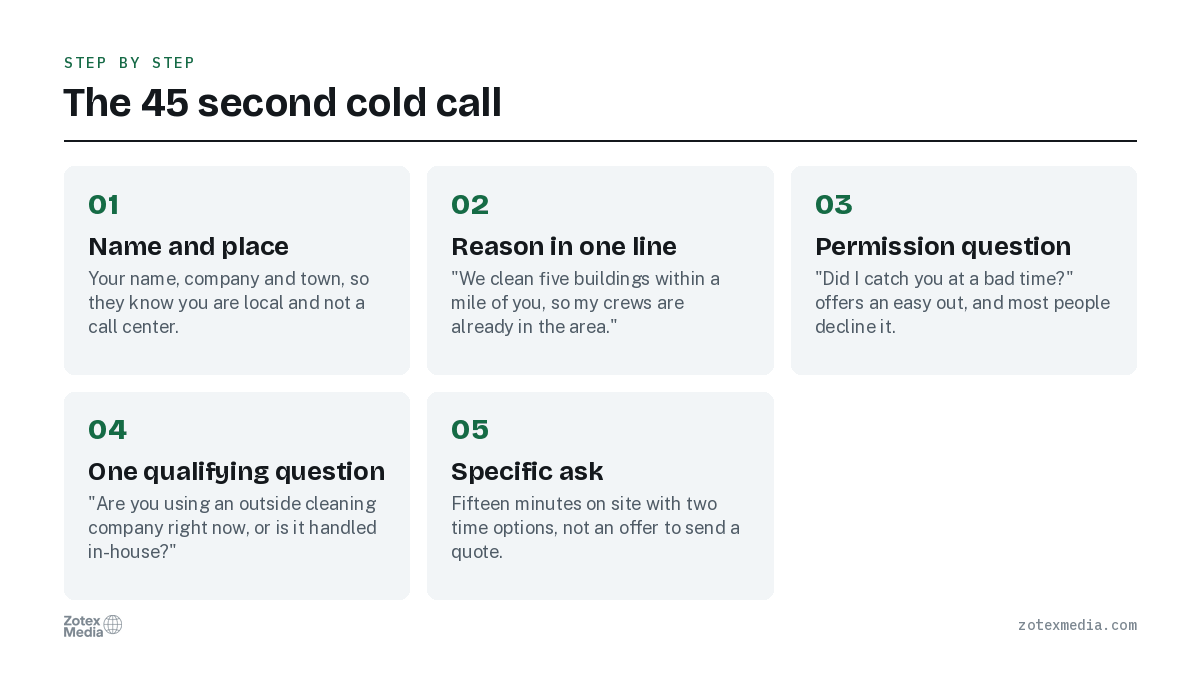
A cleaning cold call has five parts and takes 45 seconds when it goes well: name, reason, permission, one qualifying question, specific ask. Nothing else belongs in it.
Get the title right before you dial. Asking for the wrong person is the fastest way to a dead call.
- Offices under 15,000 sq ft: office manager or general manager. Scope questions are in the office playbook.
- Single-tenant buildings over 15,000 sq ft: facility manager or director of facilities.
- Multi-tenant, Class B and C: property manager, sometimes the building engineer. See how property management contracts get awarded.
- Medical and dental: practice manager or office administrator, never the doctor. Details in the medical office playbook.
- Schools and daycares: business manager, head of school, or center director. See school and daycare contracts.
- Warehouse and industrial: plant manager or operations manager, covered in the warehouse playbook.
- Multi-site chains: procurement or a regional facilities manager, and expect a bid process instead of a conversation.
Here is the opener. Use the building name if you have it, and say your town out loud.
"Hi, is this Dana? Dana, this is Mike with Brightline Facility Services, we're based here in town. I handle office cleaning on the east side. Did I catch you at a bad time?"
"Did I catch you at a bad time?" beats "how are you today?" because it offers an easy out and most people decline it. When they say "it's fine, what's up," go straight to the reason and one question.
"Quick reason for the call. We clean five buildings within about a mile of you, so my crews are already in the area. Are you using an outside cleaning company right now, or is it handled in-house?"
That question sorts your whole list. If they have a company, you want the renewal date and a complaint. If it is in-house, you want the turnover pain. One follow-up question, not four.
"Got it. When does that contract come up, and is the cleaning quality where you want it?"
Then ask for the walkthrough with two specific times. Never ask whether they would be interested in a quote.
"Here's what I'd suggest. Give me fifteen minutes to walk the space with you and I'll put a real number on paper, room by room. If my price isn't better than what you've got, you keep it and you got a free second opinion. Does Thursday at 9 work, or is Friday afternoon easier?"
Confirm three things before you hang up: the exact address, their cell number, and rough square footage. Square footage lets you pre-run the job in the cleaning service calculator so you arrive with a price range already in your head.
Get a name from the gatekeeper, skip the cold voicemail
The person answering the phone is a research tool, not an obstacle. Ask for a name, not a transfer, on the first try.
"Hey, this is Mike with Brightline here in town. Quick question: who handles the janitorial contract for the building, is that you or someone else?"
When they give you a name, get the spelling and ask one more question before you go for the transfer.
"Perfect, thanks. Is Dana usually in the mornings? Can you put me through, or should I call back at a better time?"
If they ask what it is regarding, answer plainly. Vague answers get you screened.
"I clean offices on this side of town. I'm calling to see if Dana wants a second price on the cleaning contract before it renews. Is she around?"
Voicemail only earns a message twice
On a truly cold call, skip the voicemail and move on. A message from an unknown cleaning vendor gets deleted, and it costs you the surprise on the next attempt. Log the attempt and call back at a different hour: three tries across early morning, just after lunch, and late afternoon beat one polished message.
Two exceptions. Leave one if you have a referral name, or if this is attempt three and you are about to switch to email.
"Dana, Mike with Brightline here in town, 555-0134. Ross over at the Pine Street building suggested I call you about your cleaning. Twelve seconds of your time when you get a chance: 555-0134. Thanks."
Cadence that works without being annoying: call day 1, call day 3 at a different hour, call day 8, email day 9, then park them for 90 days. Most cleaning contracts are annual, so a no in March is often a yes in September. Record every renewal date you collect, because that list is worth more than the dials that produced it.
Six objections, word for word
Six lines cover almost every cold call in this business. Learn them and stop improvising.
They say: "We already have a cleaning company."
"Good, I'd be surprised if you didn't. Most of the buildings I clean now were with someone else when I first called. All I want is to be the second bid when it comes up for renewal. When is that, roughly?"
They say: "We're happy with them."
"That's great to hear, and I'm not asking you to switch. One question: if they miss a night or lose your crew to turnover, do you have a backup? I'd like to be that call. Want me to walk it once so my number is real when you need it?"
They say: "Just send me an email."
"Happy to, and I'll do that today. The problem with emailing a cleaning price is it's meaningless until I've seen your floors and your restroom count. Give me fifteen minutes on site and the email will actually have a number in it. Are you in the building Thursday morning?"
They say: "What are your rates?"
"Depends on square footage and frequency. For an office your size, three nights a week usually runs $900 to $1,400 a month. I can tell you exactly where you fall after a fifteen minute walk. Want me to come by Thursday?"
Say a real band built from your own production rates, not "it varies." A range builds trust and screens out the caller hunting for a $200 price on a 20,000 sq ft building.
They say: "It's not in the budget."
"Understood. You're already spending something on cleaning, so this isn't new money. If I can do the same scope for less, that helps your budget. If I can't, I'll tell you and go away. Worth fifteen minutes?"
They say: "Corporate handles it."
"That makes sense. Who at corporate owns facilities, and do they run it through a bid process? I'd rather get in the right queue than bother you again."
Multi-site and public buyers post work formally instead of taking calls, including agencies on SAM.gov and state and municipal portals. Ask which portal they use and get on the vendor list. More lines like these are in the free cold call scripts and objection handlers.
The call volume math that decides everything
Cold calling fails on arithmetic more often than on wording. These are the rates to plan with, drawn from what we see when cleaning companies track dials honestly. Your market will vary.
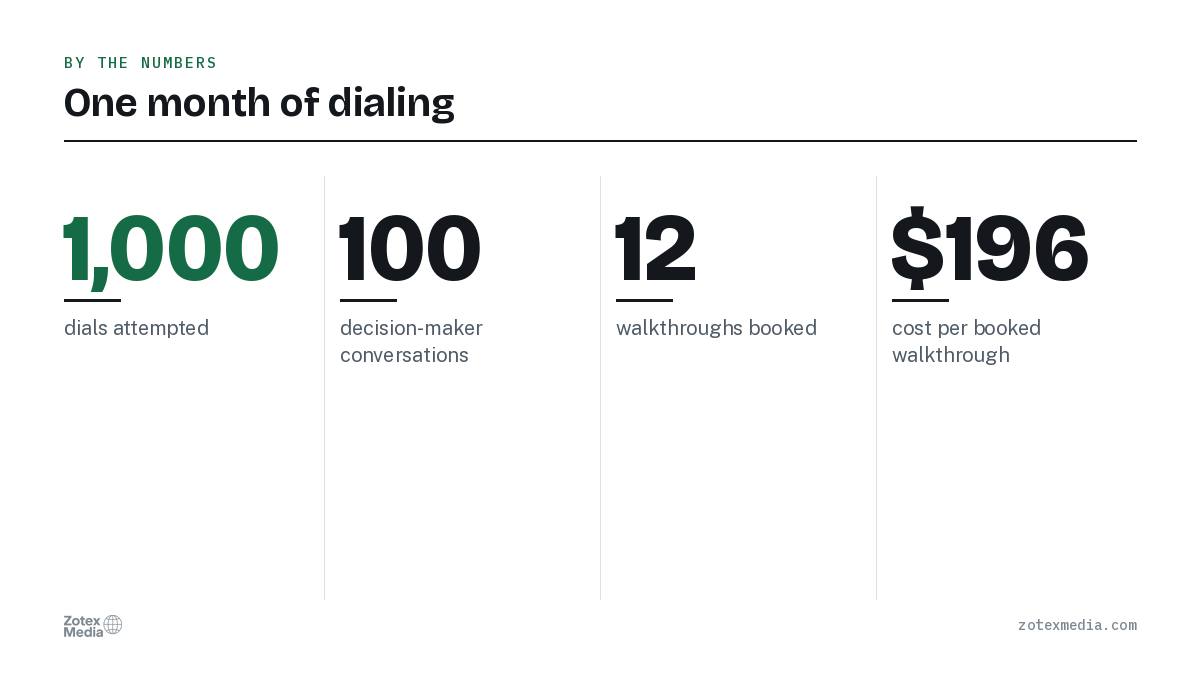
| Stage | Typical rate | Monthly result |
|---|---|---|
| Dials attempted | 10 to 12 per hour with light research | 1,000 |
| Conversations with the decision-maker | 8 to 12% of dials | 100 |
| Walkthroughs booked | 10 to 15% of conversations | 12 |
| Walkthroughs actually held | 75 to 85% of bookings | 10 |
| Contracts signed | 25 to 33% of walkthroughs held | 3 |
Cost it out. One part-time setter dialing 25 hours a week gives you about 100 dialing hours a month. At $22 an hour loaded that is $2,200, plus $150 for data and a dialer, so $2,350 all in.
Divide $2,350 by 12 booked walkthroughs and you are at $196 per walkthrough. Divide by the 3 signed contracts and acquisition cost is $783 per account. If those accounts average $1,800 a month, you added $5,400 in monthly recurring revenue, or $64,800 annualized, for $2,350 of dialing.
Run the bad case too. Halve the conversation rate and the booking rate and you get 3 walkthroughs and 1 contract: $783 per walkthrough and $2,350 per account. Still workable on an $1,800 a month contract, but only if you keep it past year one, which is why turning new accounts into long-term contracts matters more than the dialing does.
Compare the same 12 walkthroughs at $200 flat per lead: $2,400, no hiring, no ramp, no weekly coaching. On cash it is a wash. The difference is who spends the hours.
A bad list makes a good script look broken
Before anyone dials, spend a day building 500 to 1,000 records you actually want to serve.
- Pick facility types you can service tonight. If your crews cannot handle floor work, skip dealerships and gyms. The facility-type playbooks break down what each one demands.
- Draw a radius, not a region. Ten to fifteen minutes between buildings keeps supervision cheap and earns you the "we're already in your area" line.
- Filter by size, not by name. Target 8,000 to 60,000 sq ft with a named on-site manager. Skip single suites under 2,000 sq ft.
- Size the market with public data first. Business counts by industry code in the Census Bureau's County Business Patterns tell you how many targets exist in your county before you buy a single record.
- Verify the title on the first call. A large share of purchased contact data names the wrong person. Treat attempt one as research and rejection stops stinging.
For a shortcut on sizing, the metro-by-metro facility research ranks 41 metros by commercial facility counts, and the markets page shows where territories have room. For channels beyond the phone, see five ways to get more commercial cleaning leads.
Pick your model with four questions
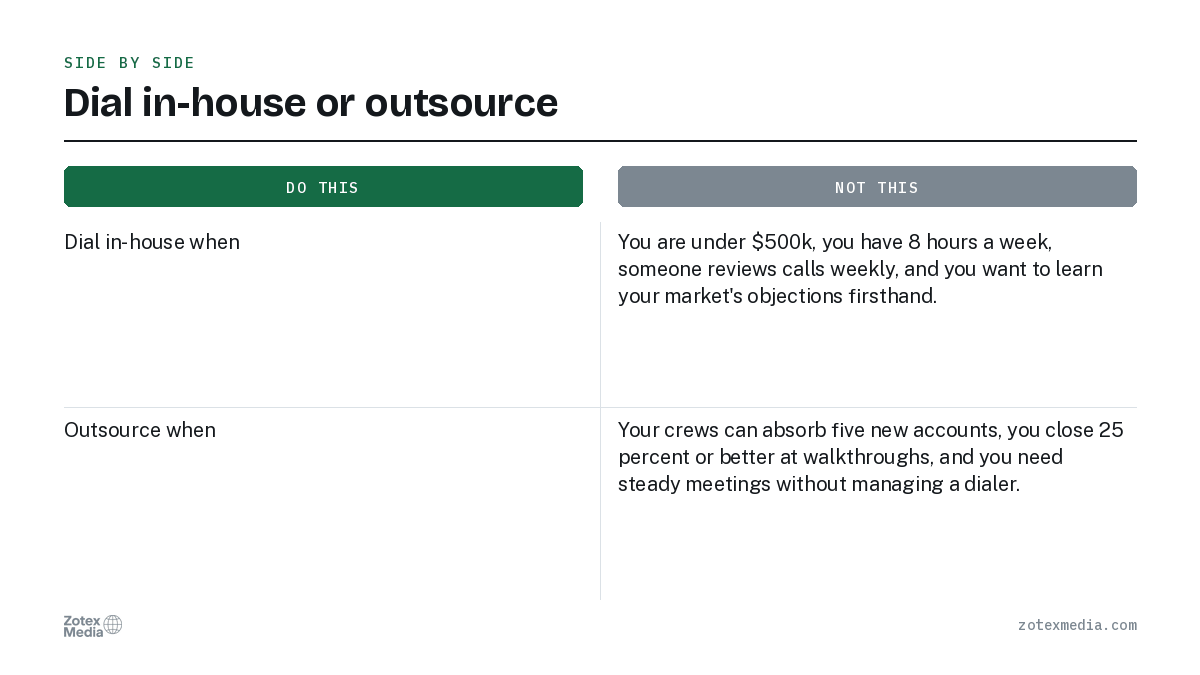
- Can you service five new accounts in 60 days? If no, do not buy leads or hire a setter. A lead you cannot service is money burned.
- What is your close rate on walkthroughs you attend? Above 25 percent, buy volume. Below 20 percent, fix pricing and the proposal first.
- Do you have 8 hours a week for the phones? If yes and you are under $500k, dial. It is the cheapest education in your market you will get.
- Will someone review recorded calls weekly? If nobody will, skip the in-house setter. Unmanaged dialers plateau early and then quit.
One more filter: consistency. Owner dialing is spiky, and a spiky pipeline means you hire crews in panic mode. If your plan needs two or three new accounts a month, you need a channel that does not stop the day a client calls about a missed night. The free scaling course covers how to sequence that with hiring.
When not to hire an agency
Plenty of cleaning companies should not outsource prospecting. Be honest about which one you are.
- You are under about $200k and it is just you. Every dollar belongs in your own dialing hours and your equipment. Buy leads once a crew can absorb the work.
- You cannot staff another building. Leads arrive whether or not you have a supervisor. Hire first.
- You close under 15 percent at the walkthrough. The problem is scope, price, or the proposal. Paying per lead makes that leak more expensive.
- You want one niche in a thin market. If there are 40 medical offices in your county, that is a two-week phone project, not a program. Do it yourself.
- You need work next week. Any outbound program takes two to four weeks to produce a first meeting. For immediate revenue, call your last twelve lost bids and your current clients about add-ons.
If quality is shaky, fix it before you add accounts. Run your buildings against a room-by-room QC checklist for a month. New contracts on a weak operation just speed up churn. When you are ready, buying commercial cleaning leads at a flat price per qualified opportunity is a fair trade for your time, and other owners describe how they use it on the testimonials page.
Common mistakes
- Pitching before asking permission. Thirty seconds of monologue gets a hang-up. Ask "did I catch you at a bad time?" and stop talking.
- Asking for interest instead of a time. "Would you be interested in a quote?" invites a no. Two specific time options book far more meetings in the call logs we review.
- Leaving voicemails on cold lists. It feels like activity and produces almost nothing. Call back at a different hour instead.
- Dialing with no price band in hand. When they ask what it costs and you stall, you lose authority. Build bands from real production rates, and ISSA publishes cleaning times you can use as a baseline.
- Quitting in week two. The first 200 dials are training. Judge the channel at 1,000 dials, not 100.
- Booking with the wrong person. A walkthrough with a coordinator who cannot approve spend wastes an hour. Ask on the phone: "Are you the one who signs off on the cleaning, or is someone else involved?"
Frequently asked questions
What is the 80/20 rule in cold calling?
Two versions apply. On your list, roughly 20 percent of records produce most of the bookings, usually right-sized buildings with a named on-site manager, so put your prep time there. On the call, the buyer should do about 80 percent of the talking after your opener, which means one question and then silence.
How to find clients for commercial cleaning?
Build a list of 500 to 1,000 buildings inside a 15 minute radius, then work three channels at once: calls to the on-site manager, daytime walk-ins, and follow-up on every renewal date you collect. County Business Patterns data tells you how many targets exist before you buy contact data. Expect 1,000 dials to produce 8 to 15 walkthroughs and 2 to 4 contracts.
What is a good script for cold calling?
Five parts in 45 seconds: name and company with your town, a one-line reason, a permission question ("did I catch you at a bad time?"), one qualifying question ("are you using an outside cleaning company or is it in-house?"), and an ask with two time options. Anything longer is a pitch, and pitches get hung up on.
What are some catchy phrases for a cleaning business?
Slogans do not book walkthroughs. What works on the phone is plain and local: "we clean five buildings within a mile of you" or "if my price isn't better, you got a free second opinion." Save the taglines for the truck wrap and spend the energy on your opener and your list.
How many calls does it take to book one cleaning walkthrough?
Plan on 70 to 100 dials per booked walkthrough with a decent list. That comes from 8 to 12 percent of dials reaching the decision-maker and 10 to 15 percent of those conversations agreeing to a meeting. A stale list can push it past 150 dials, which is a data problem, not a script problem.
Should I leave a voicemail when cold calling businesses?
Not on a first cold attempt. Log it and call back at a different hour, because three attempts across morning, early afternoon and late afternoon beat one message. Leave a voicemail only when you have a referral name or you are on attempt three and about to switch to email.
Is cold calling businesses about cleaning legal?
Business-to-business calling is handled differently from consumer telemarketing, but rules change and vary by state and province. Keep an internal do-not-call list, remove anyone who asks on the spot, and have your attorney confirm what applies before you run a high-volume program.
How much should I pay an appointment setter for a cleaning business?
Most clients pay $18 to $26 an hour fully loaded plus $25 to $75 per walkthrough that is actually held, not per booking. At 100 dialing hours a month that is about $2,350 all in with data and dialer costs, or roughly $196 per booked walkthrough at typical rates. Pay on held meetings and the no-show problem mostly disappears.
Is cold email better than cold calling for janitorial sales?
They do different jobs. Email reaches people who screen calls and gives you cheap volume, but it rarely produces a same-day commitment to a walkthrough. Calls close the loop faster, so the strongest programs run both: email to warm the name, a call within 48 hours to ask for the meeting.
Rather not make the calls yourself
Book a free strategy call and we will run your close rate against the cost of hiring a dialer versus paying a flat rate per walkthrough-ready lead.
Book Your Strategy Call