
Four lead generation companies pitched you this quarter and they all sounded the same. Different prices, identical promises.
Pricing across the category runs from $20 for a shared web form to $6,000 a month for a retainer SDR team, and the real difference is not quality, it is who eats the cost when nothing qualifies. Below: a model-by-model table, two cost models, nine vetting questions with the answers worth accepting, a reference-call script, the red flags, and a worked cost-per-contract example.
Six models, compared before you take another sales call
| Model | How leads are produced | Typical pricing | Best for | Weakest fit |
|---|---|---|---|---|
| Pay-per-qualified-lead outbound (Zotex Media and similar) | Cold email and phone to named facility decision-makers | $175 per walkthrough-ready lead, no retainer | Owners who can run a walkthrough within a week of the handoff | Companies with nobody free to do walkthroughs |
| Retainer appointment-setting agency | An SDR team dials and emails on your behalf | $2,000 to $6,000 a month plus a 3 to 6 month term | $1M+ companies with a sales manager riding the account | Under $500k, where a slow month hurts |
| Shared lead marketplace | Web forms and directory traffic, sold to several buyers | $20 to $80 per shared lead | One-time jobs: post-construction, move-outs | Recurring janitorial contracts |
| SEO and PPC agency | Inbound search demand you own over time | $1,500 to $5,000 a month plus ad spend | Metros with real commercial search volume and a 6 to 12 month horizon | Anyone who needs pipeline this quarter |
| Hourly telemarketing | Dialers working a list you supply | $20 to $45 per hour per rep | Testing a script and list you already own | Quality control, since you pay for dials not outcomes |
| In-house SDR | Your own hire, your own list | $45k to $65k base plus commission, tools and management time | $2M+ with someone to coach the role weekly | Owner-operators with no time to manage a new rep |
Every vendor in that table sells the same thing in different units: commercial cleaning leads that may or may not turn into a walkthrough. The differences that matter are structural: who creates the demand, who qualifies it, and who pays when a lead is junk.
Only two models put that risk on the vendor. Pay-per-lead and pay-per-appointment vendors earn nothing if nothing qualifies. Everyone else bills you whether or not your calendar fills. The retainer ranges above come from quotes owners have forwarded to us, not a published survey.
What you pay for, and who carries the risk
| Cost model | What triggers the invoice | Typical range | Who carries the risk |
|---|---|---|---|
| Monthly retainer | The calendar month | $2,000 to $6,000, often with a term | You |
| Retainer plus per-appointment bonus | The month plus each meeting held | $1,500 to $3,000 base plus $100 to $300 per meeting | Split |
| Pay per shared lead | Each contact record, sold to multiple buyers | $20 to $80 | You, through competition |
| Pay per qualified lead | Each decision-maker who agreed to a next step | $150 to $400, flat $175 on our pricing page | Vendor |
| Pay per booked appointment | Each meeting that lands on your calendar | $250 to $600 | Vendor, until no-shows get argued about |
Per-appointment pricing sounds cleanest until the first no-show. A 9 a.m. meeting with a facility manager who forgot is still an invoice under most agreements. Per-qualified-lead pricing skips that fight, because the gate is the decision-maker's agreement to a next step, not a calendar slot.
Before you compare quotes, price what a new account is worth to you. Run square footage and frequency through the cleaning service calculator, or bring your numbers to a free strategy call and we will run the cost-per-contract math with you.
Nine questions to ask before you sign
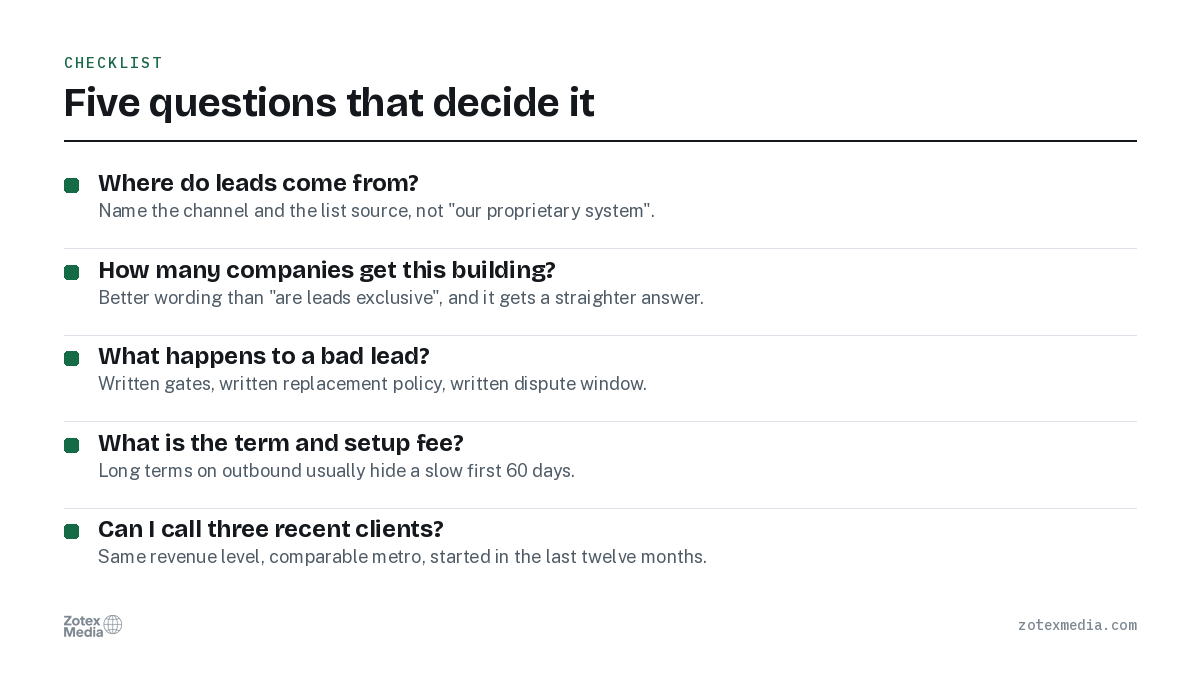
Ask them in order and write down the answers. Vague answers to questions one, three and four are the ones that cost you money.
1. Where do the leads come from, exactly?
You want a named channel and a list source, not "our proprietary system". Acceptable answers: cold email to named contacts, outbound phone calls, LinkedIn outreach, paid search, directory traffic, a partner referral network. If the answer is "a mix", ask for the percentage split.
Then ask how contacts get verified. A purchased list that bounces heavily is a different business than verified names at named buildings, and you are paying for the difference.
2. Who qualifies the lead, and against what gates?
A record should not count as a lead because a receptionist said "send info". Ask for the gates in writing. Ours are three: the contact decides on cleaning, there is a real need (a contract ending, a complaint, a move, a new building), and they agreed to a quote or a walkthrough.
Push hardest on the first gate, because the right title changes by facility size. Office manager or GM at a small office, facility manager at a large one, property manager for multi-tenant buildings, practice manager in a medical or dental office, procurement for chains and franchises.
3. Is the lead exclusive to me, and how is that enforced?
Do not ask "are your leads exclusive". Ask "how many cleaning companies will receive this building". Shared-lead sellers answer the first question with yes and the second one honestly.
Then ask what stops the same facility from being worked again next quarter for a different client. Territory exclusivity (one cleaner per metro) is a separate promise, and most vendors who claim it cannot enforce it.
4. What happens when a lead is bad?
Get the replacement policy in writing, including the dispute window. A fair policy: if the contact is not the decision-maker, had no need, or never agreed to a next step, it is replaced or refunded. If the answer is "we review case by case" with nothing written, assume you eat every bad record.
5. What is the term, and is there a setup fee?
Terms exist to protect the vendor from their own ramp time. Sometimes that is honest, since an SEO program genuinely needs six months. On outbound, a 12-month term with a $1,500 setup fee usually means the first 60 days produce nothing and they know it. Ask exactly what happens to your money if you cancel in month two.
6. What do I see in reporting?
Lead counts alone are useless. You want contact name, title, company, phone, email, building address, approximate square footage, the current situation and what they agreed to. Ask for a redacted sample record before you pay. If they will not show one, that is your answer.
7. How long until the first lead, and what is steady-state volume?
Outbound programs working from existing facility data usually produce the first qualified conversation in two to four weeks. Programs building a list from scratch take longer. Ask for the ramp curve by month in writing, including month four versus month one. Our five-step process page shows what happens between the list build and the first handoff.
8. Who owns the data and the sending domain?
If you cancel, do you keep the contact list and the email copy? Many retainer agencies say no, and two years of outreach data is worth something. Ask whose domain the email sends from, because a burned sending domain can follow you to the next vendor.
9. Can I talk to three clients who look like me?
Not their best logo. Three companies at your revenue level, in a comparable metro, who started in the last twelve months. If they can only produce one reference and it is a four-year client, the recent cohort is probably unhappy. Public client testimonials, including video, are a starting filter, not a substitute for a live call.
How we answer the nine
So you have a benchmark: leads come from outbound email and phone to facility decision-makers, never ads or marketplaces. Qualification uses the three gates above, and a lead that fails one is replaced or refunded. Every lead goes to one client only, so the same building never goes to two cleaners. Pricing is a flat $175 with no contract, no setup fee and no minimum, and you set the walkthrough time yourself.
Model by model: best fit, pricing, and the trade-off
Pay-per-qualified-lead outbound
- Best for: cleaning companies doing $200k to $5M who can run a walkthrough within five business days of a handoff.
- Pricing: $150 to $400 per lead across the category, flat $175 in our case, billed only when the gates pass.
- Trade-off: the vendor is paid for outcomes, so bad months cost them. You still have to sell. A lead is a door, not a signature.
Retainer appointment-setting agency
- Best for: companies past $1M with a dedicated salesperson and cash to fund a 90-day ramp.
- Pricing: $2,000 to $6,000 a month on a three to six month term, based on quotes owners show us.
- Trade-off: at volume, a good SDR team beats per-lead math. You also pay for activity in the months when the market is quiet.
Shared lead marketplace
- Best for: one-time work. Post-construction cleanups, move-outs, carpet jobs.
- Pricing: $20 to $80 per lead, commonly sold to three to five buyers at once.
- Trade-off: cheap and fast, but on recurring janitorial work the buyer is usually an office manager comparing four bids in an afternoon. That is a price fight you win by being cheapest.
SEO and paid search
- Best for: metros with real commercial search volume and owners who can wait two to three quarters.
- Pricing: $1,500 to $5,000 a month plus ad spend.
- Trade-off: inbound closes better than outbound, but volume is capped by demand. Check how many facilities of your target type exist near you in the facility counts by metro before you fund a search program.
Hourly telemarketing
- Best for: owners who already have a proven script and a clean list and just need dials.
- Pricing: $20 to $45 per hour per rep.
- Trade-off: the cheapest way to add call volume and the easiest to waste. Hand them a tested script from the cold call scripts and objection handlers instead of letting them write their own.
In-house SDR
- Best for: $2M+ operations with a manager who listens to calls weekly.
- Pricing: $45k to $65k base plus commission, data tools and phone systems. The Bureau of Labor Statistics publishes wage data by occupation and state if you want to sanity-check the base.
- Trade-off: long term, owning the function is cheapest. Short term, you pay salary through a four to six month learning curve, and turnover resets it.
Call three references and ask these six questions
Ask for three references, then actually call them. Keep each call to eight minutes and use these words.
- "How many leads did you get last quarter, and how many turned into a walkthrough on your calendar?" That ratio is the whole ballgame. Below half, ask why.
- "How many of those have you signed?" Then ask average monthly value so you can back into their cost per contract.
- "When a lead was bad, what happened?" You are testing whether the written policy is the real policy.
- "Did you ever find out another cleaner was working the same building?" This verifies the exclusivity answer from question three.
- "How long from signing to your first lead?" Compare it to the ramp curve the vendor gave you.
- "What do you wish you had known before you started?" The best question on the list. People tell the truth here.
Listen for whether the reference talks about leads or about contracts. If all three say the leads were fine but closing was hard, the leak may be on the cleaner's side, which is worth knowing before you blame the vendor and worth fixing with a tighter process for closing commercial cleaning deals.
Red flags that should end the conversation
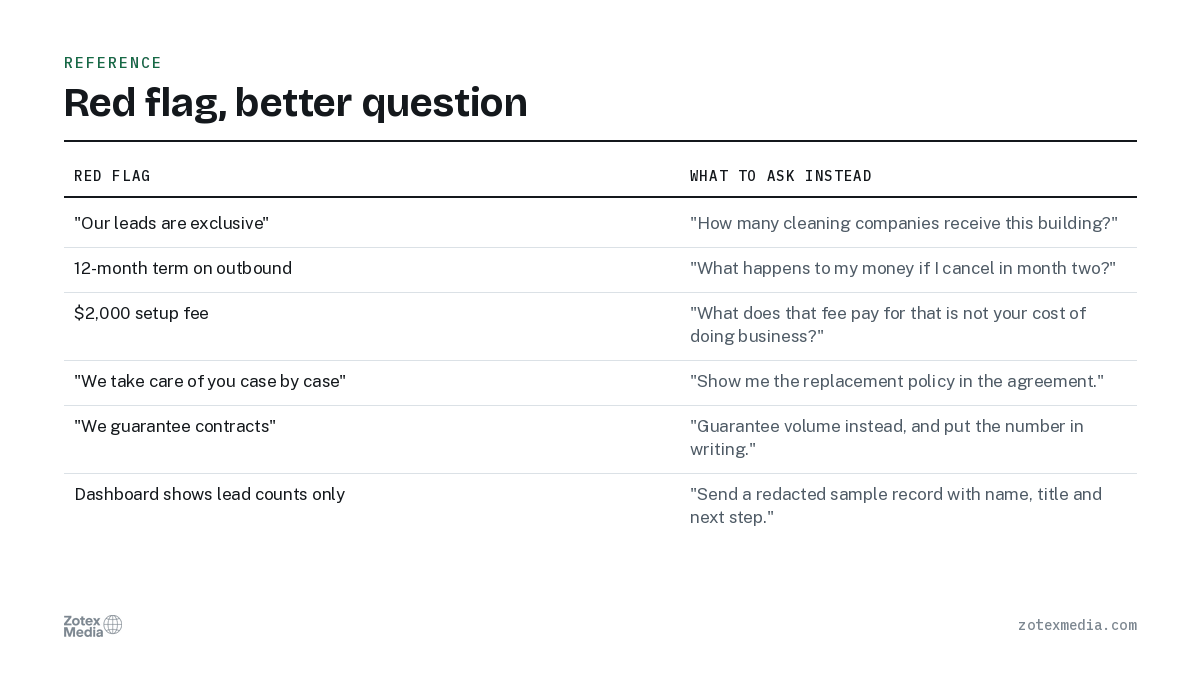
- Shared leads described as exclusive. If they dodge "how many companies get this building", they are selling the record more than once.
- A 12-month term on an outbound program. Outbound either works in 60 days or it needs fixing. The term protects them, not you.
- Setup fees over about $1,000. List building and copy are their cost of doing business, not a product.
- No written replacement policy. "We will take care of you" is not a policy. Get the gates and the dispute window into the agreement.
- Guaranteed contracts instead of guaranteed volume. Nobody can guarantee a signature they do not control. A volume guarantee is reasonable, a revenue guarantee is a tell.
- Reports without names and titles. If the dashboard says "47 leads" and you cannot see who they are and what they agreed to, you cannot audit anything.
One softer flag: a vendor who never asks what you can service. If nobody asks about crew capacity, your radius or whether you do day porter work, they are selling volume, not fit.
A decision framework you can run in ten minutes
- Write down your average contract value. Monthly recurring, not annual. Most small and mid-size accounts our clients sign land between $800 and $2,500 a month.
- Write down gross margin after labor and supplies. If you do not know it, 35% to 45% is a common band on janitorial routes. The contract structure guide covers how to protect it.
- Estimate your close rate on walkthroughs you attend. One in four is normal. One in three is good.
- Divide vendor cost by expected signed contracts. That is cost per acquired contract.
- Divide that by monthly gross profit per account. That is payback in months. Under four, buy. Over eight, keep shopping.
Run the numbers on 20 leads a month
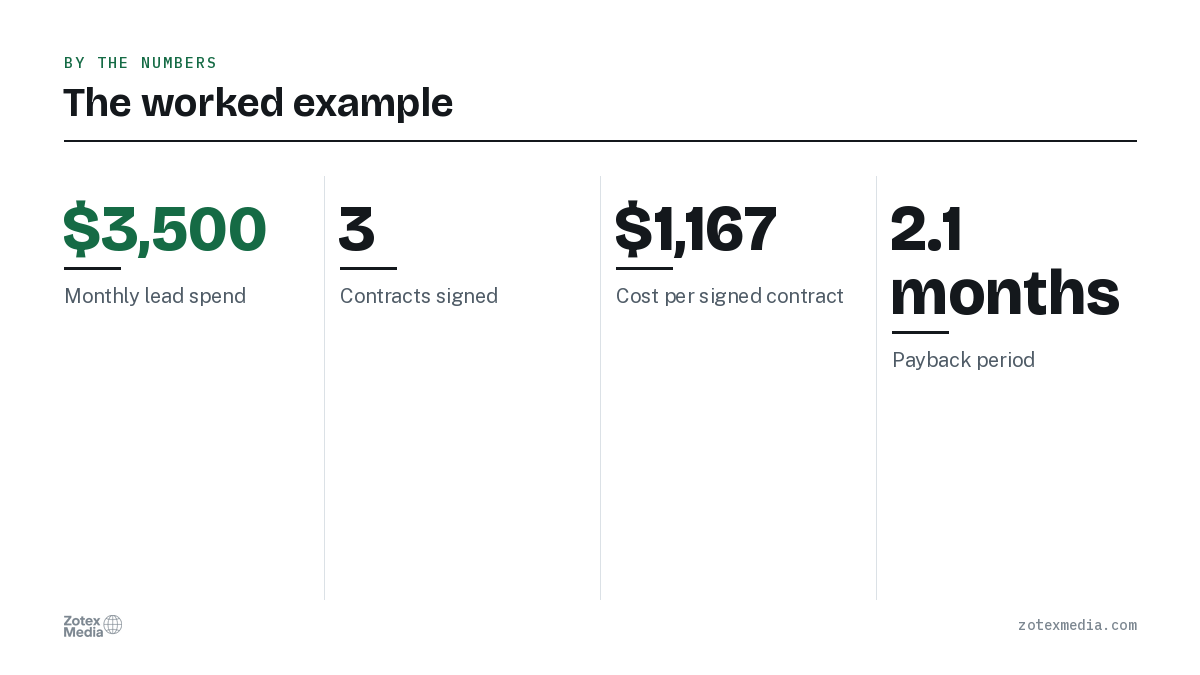
Buy 20 leads at $175 and you spend $3,500. Say 14 of the 20 turn into walkthroughs you actually run, which is roughly what we see when owners follow up inside 48 hours. Close 25% of those and you sign 3.5 contracts, call it 3 to stay conservative.
At $1,400 a month and 40% gross margin, each account throws off $560 a month in gross profit. Cost per signed contract is $3,500 divided by 3, or $1,167. Payback is $1,167 divided by $560, which is 2.1 months. Across twelve months those three accounts represent $50,400 in new revenue from a $3,500 spend, if they stay.
That last word does the heavy lifting. Lose one account in month five and your real cost per retained contract jumps to $1,750. The retention playbook and a room-by-room QC checklist move that number more than negotiating $20 off the lead price.
Now run the same math on a $4,000 retainer. Eight meetings puts you at $500 per meeting, and at the same close rate that is 2 contracts for $4,000, or $2,000 each. Not automatically worse, but it has to produce more meetings to beat per-lead pricing, and you pay either way.
When not to hire a lead generation company
- You cannot staff what you would win. If three new accounts next month would break your crew schedule, fix hiring first. Nothing kills a young cleaning company faster than work it cannot service.
- Nobody can run the walkthrough. Leads expire. A decision-maker who agreed to a quote Tuesday and hears from you the following Monday is a cold lead with a price tag.
- Your free channels are not tapped out. Current customers, past bidders, your bank, your supplier reps. The five ways to get more leads post covers the ones that cost time instead of money.
- You are chasing government or institutional work. Those contracts get posted publicly, not sold as leads. Federal opportunities sit on SAM.gov, and most states and school districts run their own bid portals.
Common mistakes
- Comparing price per lead across different definitions. A $40 shared lead and a $175 qualified lead are not the same unit. Normalize to cost per walkthrough you actually run.
- Judging a program on the first 30 days. Outbound ramps. Look at weeks 5 through 12, and hold the vendor to the curve they put in writing.
- Blaming the vendor for a sales problem. If you got 15 leads, ran 6 walkthroughs and sent 3 proposals, the leak is yours. Tighten the follow-up window and use a standard proposal template.
- Buying leads for facility types you have never cleaned. A gym or a medical suite carries requirements an office does not. Read the relevant playbook in the facility-type hub first.
- Skipping the reference calls. Three calls take 25 minutes and are the highest-return thing on this page.
- Ignoring your own capacity math. ISSA publishes standard cleaning times you can use to check whether your crew absorbs three new buildings before you fund a pipeline.
Frequently asked questions
How much do commercial cleaning lead generation companies charge?
Three price points dominate. Shared leads run $20 to $80 each, qualified leads run $150 to $400 (we charge a flat $175), and retainer agencies quote $2,000 to $6,000 a month plus a term. Normalize everything to cost per walkthrough you actually run before you compare.
Are exclusive leads worth paying more for?
Usually yes, because shared leads turn into price-only bidding. A building sold to four cleaners means the buyer opens with "what is your number" instead of "when can you walk it". The test is not the word exclusive, it is the answer to "how many cleaning companies receive this building".
What close rate should I expect on purchased janitorial leads?
On qualified leads where the decision-maker agreed to a next step, expect 60% to 75% to become walkthroughs if you follow up inside 48 hours, and to close 20% to 30% of those. That is roughly 3 contracts per 20 leads. Shared marketplace leads convert far lower.
Should I pay a setup fee?
A few hundred dollars for data and onboarding is defensible. Anything over about $1,000 is the vendor getting paid before delivering anything, and it is almost always negotiable. We do not charge one, and plenty of competitors will drop theirs if you ask.
How long before a janitorial lead generation service produces results?
Outbound programs using existing facility data typically produce the first qualified conversation in two to four weeks and reach steady volume around month three. SEO and content programs need six to twelve months. Ask for the ramp curve by month in writing, then hold them to it.
What is the difference between a lead and a booked appointment?
A qualified lead is a decision-maker with a real need who agreed to a quote or a walkthrough, with you setting the time. A booked appointment is a specific slot on your calendar. Appointments cost more, commonly $250 to $600, and create no-show disputes, which is why some vendors sell the lead and let you schedule.
Can I just build lead generation in-house instead?
You can, and past about $2M it is usually cheaper. Budget $45k to $65k base plus commission, data tools and four to six months of ramp, plus an hour a week listening to calls. If nobody will manage the role, you pay for a seat and get nothing.
What should a replacement policy actually say?
It should name the gates (decision-maker, real need, agreed next step), state that a lead failing any gate is replaced or refunded, and give you a dispute window of at least 5 to 10 business days. If any of those three is missing from the written agreement, assume you absorb every bad record.
Get all nine answers in one call
Bring your contract value, margin and close rate to a free strategy call, and we will run the cost-per-contract math with you before you buy a single lead.
Book Your Strategy Call