
A vendor quotes you $200 a lead. The owner across town pays $40 and swears by it.
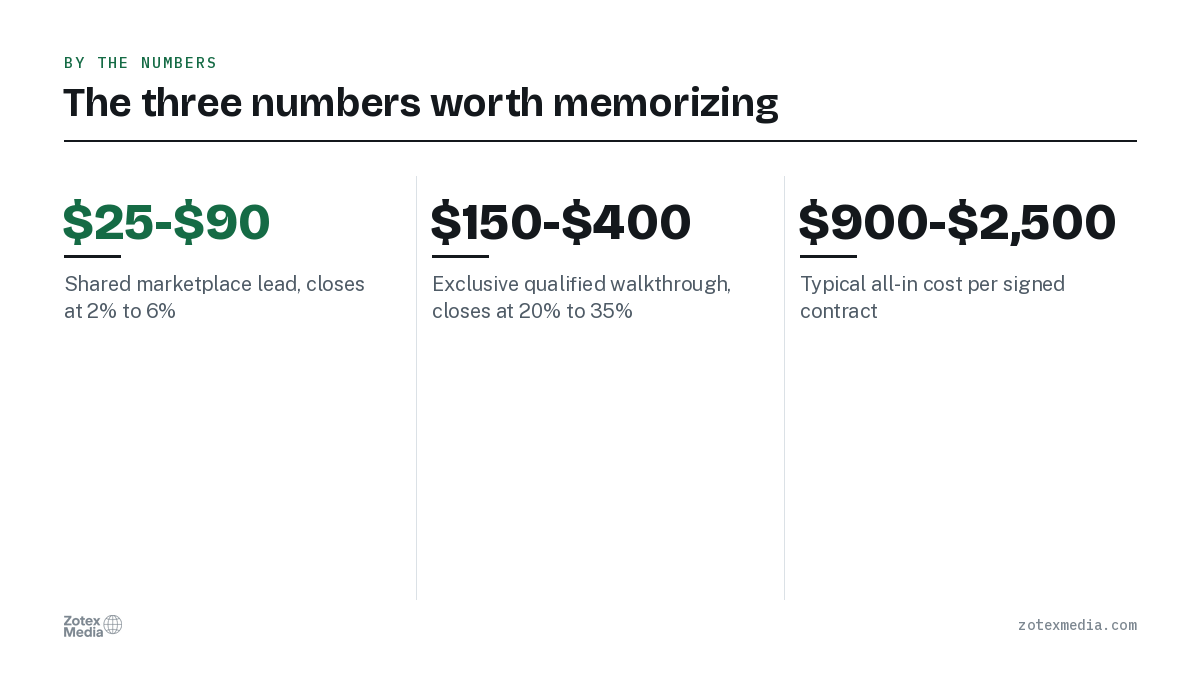
Commercial cleaning leads run roughly $25 to $90 for a shared marketplace lead, $60 to $200 for a paid search inquiry, and $150 to $400 for an exclusive appointment with a decision maker who already agreed to a walkthrough. None of those prices mean anything until you multiply them by your close rate and your average contract value, which is how a $40 lead ends up costing more per signed contract than a $225 one. What follows: three tables, two worked examples, an add-on cost list, and a five-step model that collapses all of it into one number you can manage.
What each type of cleaning lead costs and closes at
The ranges below are what we see across our clients and what owners report when they compare notes. They are not published benchmarks, and they move with metro, facility type and how hard you chase.
| Lead type | What you actually get | Typical cost each | Typical close rate |
|---|---|---|---|
| Your own inbound (SEO, Google Business Profile) | A form fill or call from someone searching | $0 to $60 in allocated cost | 15% to 30% |
| Paid search inquiry | A form fill, often mixed commercial and residential | $60 to $200 | 8% to 15% |
| Shared marketplace or directory lead | Contact info sold to three to five cleaners | $25 to $90 | 2% to 6% |
| Purchased contact data (not a lead) | A name, title, phone and email | $0.10 to $0.60 per record | Under 1% per record |
| Self-generated cold appointment | A walkthrough your own caller booked | $300 to $600 all-in | 15% to 25% |
| Exclusive qualified walkthrough (outbound agency) | Decision maker, real need, agreed next step | $150 to $400 | 20% to 35% |
| Referral from a client, broker or GC | A warm introduction | $0 to a finder fee | 40% to 60% |
The spread in close rate is wider than the spread in price. A $40 lead that closes at 3% costs $1,333 per contract. A $225 lead that closes at 25% costs $900. The cheap lead is the expensive one.
For a reference point on the paid side, Zotex charges a flat $225 per qualified walkthrough with no retainer, listed on the pricing page. A cost article that hides its own number is not worth much to you.
Cost per lead is a vanity number, cost per contract is not
Cost per lead tells you what you spent. It says nothing about what you got. Two companies can buy the identical lead and land in different economics because of what happens after it arrives.
- Quality varies inside the same price. A "lead" can be a name on a list or a facility manager who blocked 30 minutes on Thursday. Same word, ten times the value.
- Close rate is mostly you. Response speed, walkthrough process and proposal quality swing close rate by 10 points or more. Our free proposal template exists because weak proposals kill good leads.
- Contract value differs by facility. A 4,000 square foot dental suite and a 90,000 square foot distribution center are both one lead and nowhere near the same prize.
- Contract length compounds everything. A deal that renews for three years is worth three times a deal that churns at month twelve, for the same acquisition cost.
Track cost per signed contract, then cost per signed contract as a share of what that contract is worth. Everything else is noise.
Pull these four numbers before you call a vendor
Get these out of your own books first. If you do not have them, estimate, mark the estimate, and correct it in 90 days.
1. Average monthly contract value
Add up recurring monthly billing and divide by accounts. Most owners we talk to land between $900 and $2,200. Under $700, your acquisition math will always be tight, and the fix is bigger buildings, not cheaper leads.
2. Close rate, by lead source
Signed contracts divided by walkthroughs performed, not by leads received. Track it per source. One source is usually carrying everything.
3. Average contract length
Look at your last ten accounts that ended and count the months. Janitorial accounts typically run 18 to 36 months when service holds. Our post on turning one-time clients into long-term contracts covers how to push the top of that range.
4. Gross margin after direct labor and supplies
Not net profit. Revenue minus cleaner wages, payroll burden and supplies. Most operators we see run 25% to 40%. Use your own middle, not your best month.
| Facility type and size | Who signs | Typical monthly contract | Typical sales cycle |
|---|---|---|---|
| Small office suite, under 15,000 sq ft | Office manager or GM | $400 to $1,200 | 1 to 3 weeks |
| Large single-tenant office, 40,000 sq ft and up | Facility manager | $2,500 to $12,000 | 1 to 4 months |
| Multi-tenant building or portfolio | Property manager | $800 to $3,000 per building | 3 to 8 weeks |
| Medical or dental practice | Practice manager | $700 to $2,500 | 2 to 6 weeks |
| Regional chain (dealerships, gyms, clinics) | Procurement or category manager | $1,500 to $6,000 per site | 3 to 9 months |
Sales cycle matters as much as price. A chain lead at $225 is cheap, but revenue is two or three quarters out. If you need cash in 60 days, buy leads in the top four rows. The facility-type playbooks break down what each buyer asks for, including the office building playbook and the medical office playbook.
Build your cost per signed contract in five steps
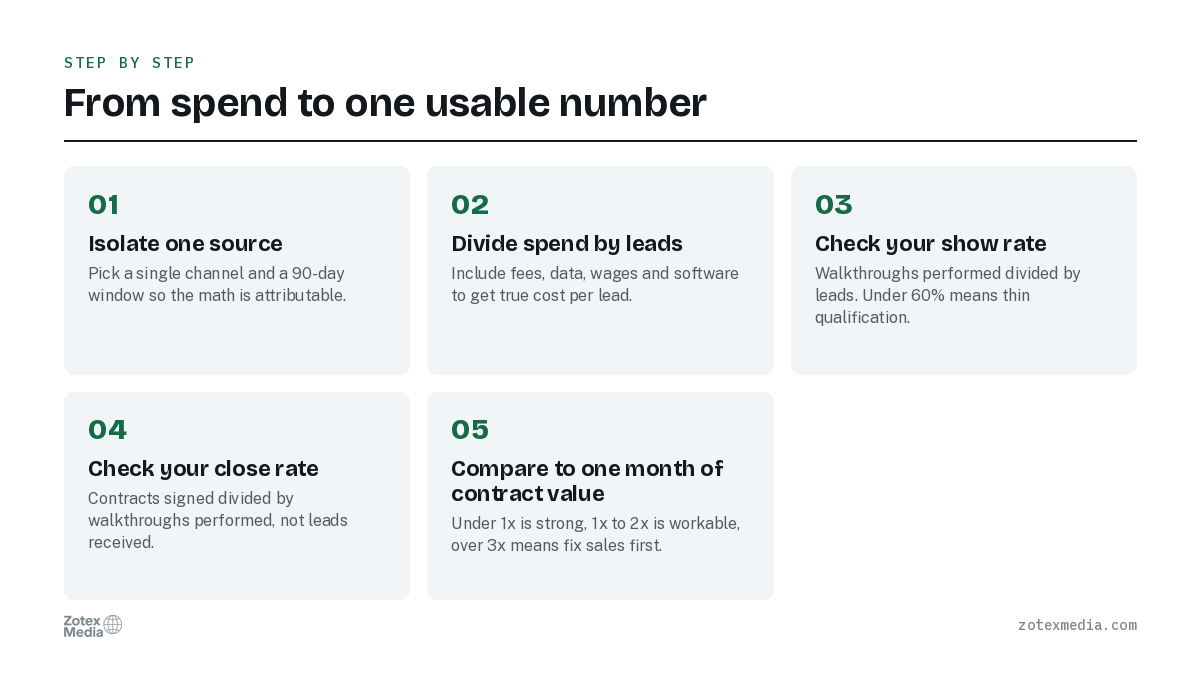
- Pick one source and one 90-day window. Mixing sources hides which one works.
- Divide total spend by leads received. Include the lead fee, the data, the caller's wage and the software. That is your true cost per lead.
- Divide walkthroughs performed by leads. That is your show rate. With cold appointments, 70% to 85% is normal. Under 60% means the qualification is thin.
- Divide contracts signed by walkthroughs performed. That is your close rate. Cost per signed contract is total spend divided by contracts.
- Compare that to one month of contract value. Under 1x is strong. One to 2x is workable if contracts last two years. Over 3x, fix close rate before you buy more.
That last ratio is the whole discipline. It stops the argument about $40 versus $225 and starts the argument about what a signed account is worth.
Worked example: 20 qualified walkthroughs for $4,500
Round numbers, one source, no fudging.
- Spend: 20 walkthroughs at $225 = $4,500.
- Show rate: 18 of 20 happen. Two reschedule into next quarter.
- Close rate: 22%, so 4 contracts signed.
- Average monthly contract value: $1,400.
- Gross margin: 35%.
Cost per signed contract is $4,500 divided by 4, or $1,125. That is 0.8x one month of contract value, so it passes. New recurring revenue is 4 x $1,400 = $5,600 a month, and gross profit on that is $1,960 a month.
Payback is $4,500 divided by $1,960, or 2.3 months. Over a 24-month contract life those four accounts bill $134,400 and produce $47,040 in gross profit against $4,500 of acquisition cost, about 10x. Acquisition cost as a share of first-year revenue ($67,200) is 6.7%, inside the 5% to 10% of revenue that most growing small businesses plan for sales and marketing, a range worth sanity-checking against SBA small business planning guidance.
Change one input. At a 10% close rate, 18 walkthroughs produce 2 contracts, cost per contract goes to $2,250, and payback stretches to 4.6 months. Still workable. At 5% you are at $4,500 per contract, and the problem is your sales process, not the price of the lead. Run your own numbers through the free service calculator, or bring them to a free strategy call and we will do the arithmetic with you.
Worked example: your own caller at $538 a walkthrough
Building it in-house is a real option and plenty of owners should do it. Here is the honest comparison.
The monthly cost
- Wage: a part-time setter at 25 hours a week and $22 an hour is $2,383 a month. Check your metro against BLS occupational wage data before you set the rate.
- Payroll burden: employer Social Security and Medicare alone run 7.65% per the IRS employer tax rules, and unemployment plus workers comp push total burden near 12%. Call it $2,670.
- Contact data: $150 a month for verified facility contacts.
- Dialer, phone numbers and CRM: $180 a month.
- Email sending and list verification: $150 a month.
- Your management time: four hours a month at $100 an hour of opportunity cost, or $400.
Total: about $3,550 a month, or $42,600 a year. Add $1,000 for hiring and training and year one is $43,600.
The output
A trained caller working 108 hours a month makes 1,800 to 2,400 dials, holds 80 to 120 real conversations with decision makers, and books 6 to 12 walkthroughs once ramped. Ramp is the part owners forget: months one through three usually produce about three a month.
Year one: 9 walkthroughs in the ramp quarter plus 8 a month for nine months = 81. That is $43,600 divided by 81, or $538 per walkthrough. At a 20% close rate that is 16 contracts, or $2,725 each. Year two, no ramp, 96 walkthroughs, works out to $444 each and $2,220 per contract.
Those 16 contracts at $1,400 add $22,400 a month in recurring revenue by the end of year one, or $7,840 a month in gross profit against a $3,550 monthly cost. In-house works, gets cheaper in year two, and leaves you an asset. It also rests on one person you have to keep, coach and eventually replace. Hand your caller the cold call scripts and objection handlers on day one instead of letting them write their own.
Retainer, pay per lead or in-house: who carries the risk
| Model | How you pay | Typical range | Best for | Main risk |
|---|---|---|---|---|
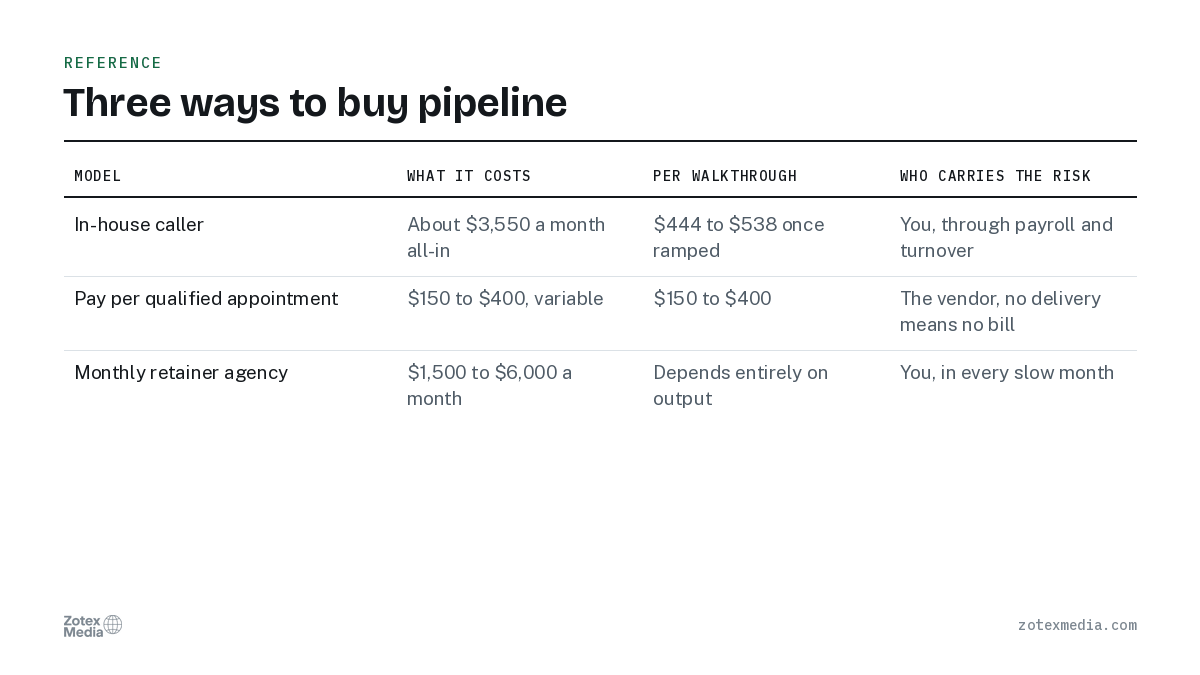
| Monthly retainer agency | Fixed fee regardless of output | $1,500 to $6,000 per month | Owners who want brand plus pipeline | You pay in slow months too |
| Pay per raw lead | Per contact or form fill | $25 to $90 | High-volume, low-ticket work | Shared leads, low close rate |
| Pay per qualified appointment | Per booked walkthrough | $150 to $400 | Owners who can sell but hate prospecting | Wasted spend if you cannot close |
| In-house caller | Wage plus tools | $3,000 to $5,500 per month | Companies over roughly $1M | Turnover and 90 days of ramp |
| Owner selling direct | Your own hours | 8 to 12 hours a week | Under $500k in revenue | Stops the day you get busy |
These models are not morally different, they just move risk. A retainer puts output risk on you. Pay per qualified appointment puts it on the vendor. In-house puts it on your ability to manage one employee. Pick based on your cash position, not on which one sounds cheaper.
One rule regardless of model: do not buy shared leads and exclusive appointments in the same month and then blame a vendor when your blended close rate drops. If you want to see how appointments get qualified before delivery, the five-step process page lays out the gates.
Payback under three months means buy more
Take cost per signed contract, divide by the monthly gross profit that contract produces, and you have the months until the deal is free.
- Under 3 months: buy more, faster. You are converting cash into recurring revenue at a good rate.
- 3 to 6 months: healthy for most operators, if you have the working capital to carry payroll while you wait.
- 6 to 12 months: only defensible if accounts genuinely last two years or more and you measure churn.
- Over 12 months: stop. Fix close rate, contract value or margin first.
Working capital is the constraint owners actually hit, not ROI. Every new account needs supplies, a first payroll cycle and often equipment before the first invoice clears at net 30. Going from 20 to 30 accounts in a quarter can strain cash even when every contract is profitable. Our notes on structuring contracts for profit cover payment terms that shrink that gap.
The costs nobody budgets for add about $125 an appointment
Owners quote the invoice and forget the rest. Here is the add-on list with typical monthly ranges.
- CRM: $25 to $150. Without one you will lose follow-ups and never know it.
- Contact data and verification: $100 to $400. Bad phone numbers are the quietest waste in outbound.
- Dialer and phone numbers: $30 to $100 per seat.
- Email domains, warmup and sending: $80 to $300 if you run cold email properly.
- Proposal and e-signature tools: $15 to $50.
- Your time at walkthroughs: 1 to 2 hours per site including drive time. At $75 to $125 an hour of owner value, that is $75 to $250 per appointment whether you win or lose.
- Bid portals: registration on SAM.gov for federal work is free, while private aggregators charge annual subscriptions from a few hundred dollars to over a thousand.
Add your walkthrough time to any per-appointment price to get the real figure. A $225 appointment plus 90 minutes of your time is closer to $350 all-in. That is fine at a 20% close rate on a $1,400 account. It is not fine at a 5% close rate on a $500 account, and you should know which one you are before you sign up for anything.
Five questions to ask when someone quotes a cheaper lead
You will get an offer at $49 a lead. Sometimes it is a good deal. The difference usually shows up in one of these five answers, so ask directly.
- "Is this lead exclusive to me?" If it goes to four cleaners, you are in a price race before you say hello. Exclusivity is the biggest single driver of close rate.
- "Did the contact agree to a next step?" There is a wide gap between a form fill and someone who agreed to a walkthrough on a specific day.
- "Is the contact the person who signs?" A receptionist's email is data. A facility manager who owns the cleaning budget is a lead.
- "What happens if the lead is garbage?" Replacement or refund policy in writing. Vague answers here tell you everything.
- "Is there a contract, setup fee or minimum?" Cheap per unit plus a $2,000 onboarding fee is not cheap.
Then run the same arithmetic on both offers. A $49 lead closing at 4% costs $1,225 per contract before your time. A $250 appointment closing at 25% costs $1,000. Buy the better cost per signed contract, and when the two land within 20% of each other, buy the one that eats less of your follow-up time.
Do not skip the free sources while you are at it. Referrals, current-client expansion and property manager relationships still close highest in the table at the top, and our list of five ways to get more commercial cleaning leads covers them without a budget.
Track six columns and your real number appears in 90 days
One spreadsheet, updated weekly: source, spend, leads, walkthroughs performed, contracts signed, first-year contract value. Ninety days of that beats any vendor's case study.
Two habits pay for themselves. Tag every contract with the source that started it, including the referral that came from a client you bought two years ago. And re-run close rate every quarter, because a bad hire or a slow proposal turnaround moves it before anything else in your business shows a symptom. If closing is the leak, read how to close commercial cleaning deals before you spend another dollar on pipeline.
Common mistakes
- Judging a source on fewer than 15 leads. At a 20% close rate, five leads with zero contracts is statistically normal. Owners kill working channels on samples of three.
- Comparing prices across different products. A shared directory lead and an exclusive booked walkthrough are not the same item, so their prices are not comparable.
- Ignoring speed to lead. Responding in an hour instead of a day routinely moves close rate by double digits. Calling back faster is the cheapest improvement available.
- Buying leads for buildings you cannot staff. With no crew within 25 minutes of the site, you either lose the bid or lose money on it. Check coverage on the markets page or the metro market research.
- Counting new revenue while ignoring churn. Adding four accounts and losing three is a treadmill. Acquisition cost only makes sense next to retention, which is where a documented QC inspection process earns its keep.
- Blaming lead quality for a sales problem. If every source closes under 8% for you, the vendor is not the common factor.
Get those six right and lead price becomes a minor line item. Get them wrong and no price is cheap enough. Everything above works without buying a single commercial cleaning leads package from anyone.
Frequently asked questions
How to find commercial cleaning leads?
Four sources produce almost all commercial work: outbound calling and emailing facility decision makers, referrals from clients and property managers, local search visibility, and bid portals like SAM.gov for public work. Outbound is the only one you can turn up on demand, which is why it carries the highest cost at $150 to $400 for a booked walkthrough. Referrals close at 40% to 60% and cost nothing, so build that habit before you buy anything.
How do I get clients for my commercial cleaning business?
Pick one facility type, build a list of 300 to 500 buildings inside your service radius, and contact the person who owns the cleaning budget: the office manager at small sites, the facility manager at large ones, the practice manager at medical offices. Expect 1,800 to 2,400 dials to book 6 to 12 walkthroughs in a month, and expect to close 15% to 25% of those. That is one to three new accounts a month at a typical $900 to $2,200 each.
How do cleaning companies get leads?
Most companies under $1M rely on the owner selling part-time plus referrals. Between $1M and $5M, the pattern shifts to a dedicated appointment setter at about $3,550 a month all-in, or paying per qualified appointment at $150 to $400, or both. Above that, companies usually run a small sales team and bid on RFPs through public and private portals.
What is a good cost per lead for a commercial cleaning company?
There is no good cost per lead, only a good cost per signed contract. Target a cost per signed contract below 1x your average monthly contract value, and treat up to 2x as acceptable if accounts last two years or more. At $1,400 a month average, that means paying up to about $1,400 to win an account, which at a 20% close rate supports a lead price near $280.
Is pay per lead better than a monthly retainer?
It depends on your cash position and your confidence in your close rate. A retainer at $1,500 to $6,000 a month is cheaper per unit when the agency produces volume and more expensive when it does not, because you pay in slow months either way. Pay per appointment at $150 to $400 costs more per unit but only bills when something is delivered, which suits uneven cash flow.
How many leads do I need to sign one contract?
With exclusive, qualified walkthroughs, plan on 4 to 6 appointments per signed contract at a 20% to 25% close rate. With shared marketplace leads, it can take 20 to 40. Track it per source for 90 days, because your own number is the only one that should drive your budget.
Run your cost per signed contract with us
Bring your close rate and average contract value to a free strategy call. We will do the math with you and tell you straight if paying per walkthrough makes sense.
Book Your Strategy Call