
You walk the building, nod a lot, then sit in your truck and guess at a number. That guess is why you lose work you should have won and win work that bleeds for 24 months. A commercial cleaning bid is four numbers: labor hours, loaded wage, supplies and equipment, then overhead and profit. Get those right and a 20,000 square foot office cleaned five nights a week prices near $4,300 a month, about $0.21 per square foot. Below: 7 steps, the production rates that set your hours, the labor build-up, one worked example carried to a final price, and the six mistakes that eat margin.
The 7 steps from walkthrough to signed bid
Every profitable bid follows the same order. Skip a step and you spend the rest of the process back-solving a number you already said out loud.
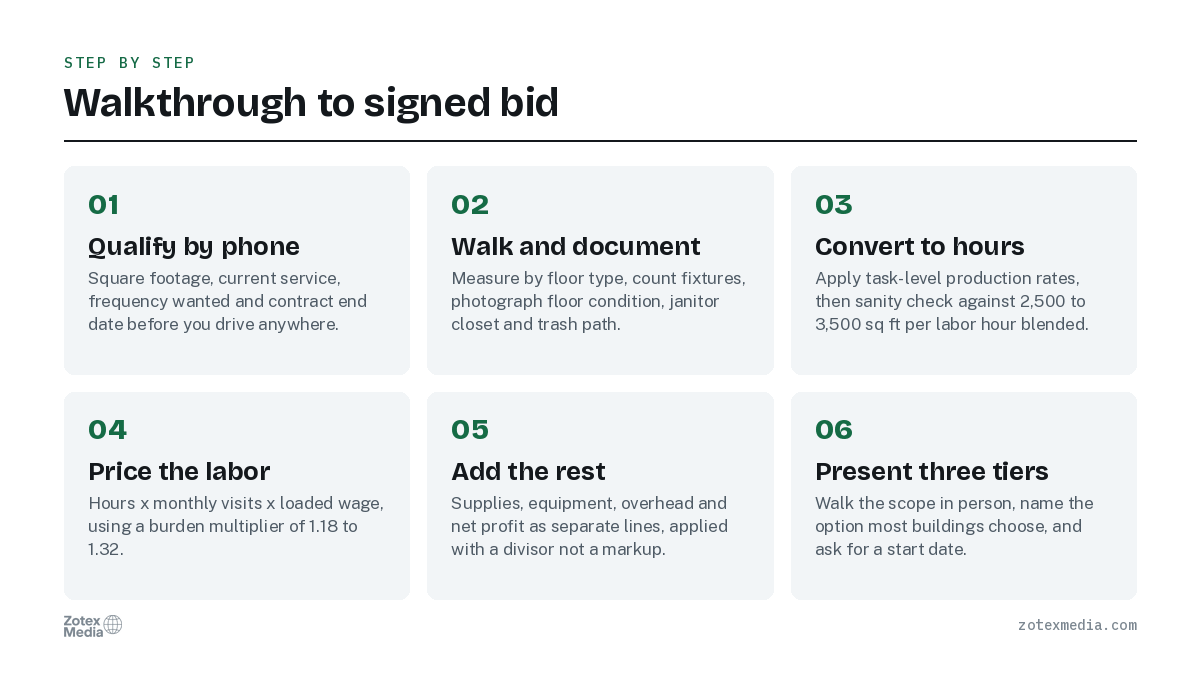
- Qualify before you drive. Get square footage, who cleans it now, the frequency they want, and when the current contract ends.
- Walk the building with a measuring wheel and your phone. Measure by floor type, count fixtures, photograph everything you will have to clean or protect.
- Convert square feet to labor hours using production rates by task, not one blended guess for the whole building.
- Price the labor at a loaded wage that includes payroll taxes, workers compensation and paid time off.
- Add supplies, equipment, overhead and profit as separate lines so you know what you can cut and what you cannot.
- Build three tiers at different frequencies, with periodic floor work priced separately.
- Present it live, walk them through the scope line by line, and ask for a start date before you leave.
Steps 1 and 7 decide most deals. The arithmetic in the middle only protects you once you have the meeting, so if meetings are the bottleneck, start with the five ways to get more commercial cleaning leads and the free cold call scripts and objection handlers.
The buyer's title decides your timeline and your process
A 6,000 square foot insurance office and a 200,000 square foot distribution center are not the same sale, even when the per hour math is identical. Know who signs before you price.
Buyer titles by facility size
- Under 15,000 sq ft office: the office manager or the owner signs. One meeting, one decision, often closed inside two weeks.
- 50,000 sq ft and up: a facility manager runs it, and above an internal dollar threshold it goes to a formal bid with three quotes.
- Multi-tenant buildings: the property manager signs and bills it back through common area charges. The property management cleaning playbook covers how those portfolios buy.
- Medical and dental: the practice manager owns it, and the doctor only hears about it when something goes wrong. Details in the medical office cleaning contracts guide.
- Chains and multi-site: procurement or a regional facilities director, with an RFP and a scoring sheet.
Contract types, value and where they come from
| Contract type | Typical monthly value | Typical frequency | Who signs | Where you find them |
|---|---|---|---|---|
| Small office suite (3k to 10k sq ft) | $400 to $1,200 | 2 to 5 nights | Office manager or owner | Cold outreach, referrals |
| Class B office building (20k to 60k) | $2,500 to $9,000 | 5 nights plus porter | Facility or property manager | Property management firms, direct outreach |
| Medical or dental office | $900 to $3,500 | 3 to 6 nights | Practice manager | Direct outreach, equipment rep referrals |
| Daycare, private school, district | $1,500 to $12,000 | 5 nights | Business manager or district procurement | District sites, state bid portals |
| Warehouse or industrial | $2,000 to $15,000 | 3 to 7 days | Plant or operations manager | Direct outreach, SAM.gov for federal |
Those bands track local wages, so they run high in coastal metros and low in the Midwest. Nine facility types are broken down further in the cleaning contracts by facility type hub.
Measure these numbers on the walkthrough or you are guessing
The walkthrough is data collection, not a performance. Leave without these numbers and the bid becomes a feeling.
Measure and count
- Cleanable square footage by floor type. Carpet, VCT, polished concrete, sealed wood, ceramic. Not gross building area, which includes walls, shafts and space you never touch.
- Restrooms and fixtures. Count toilets, urinals and sinks separately. Restrooms burn more labor per square foot than anything else in an office.
- Trash setup. Desk-side cans versus centralized bins can swing a 150 person office by 20 to 40 minutes a night.
- Entrances, elevators and stairwells. Each is a fixed time block that does not scale with square footage.
- Breakrooms and kitchens. Ask who cleans the microwave, the fridge and the dishes, then write the answer into the scope.
Photograph these five things
- Floor condition. Stripped-out VCT or matted carpet tells you the last company was underpriced and under-staffed.
- Restroom grout and fixtures. Document the stains you are not being paid to remove.
- The janitor closet. No closet, no hot water or no dump sink changes your equipment plan and your hours.
- Dock, dumpster and trash path. A 300 foot trash walk is real labor, five nights a week.
- Existing damage. Chipped desks, broken dispensers, stained ceiling tiles.
Ask four questions before you walk out: what is not working with the current service, what budget range were you given, who else signs off, and when do you want to start. Those answers move the deal more than the measurements do when you get to closing the deal.
Production rates turn square feet into labor hours
A production rate is the area one trained cleaner covers in one hour at a given task. Build the bid from task-level rates and add them up. One blended number for a whole building hides restrooms, which is where the hours actually go.
| Task or area | Typical rate per labor hour | Where it slows down |
|---|---|---|
| Open office, carpet: trash, dust, vacuum | 3,000 to 4,500 sq ft | Desk-side cans, clutter, cubicle mazes |
| Private offices and conference rooms | 2,000 to 3,000 sq ft | Glass tables, locked doors, badge access |
| Hard floor: dust mop and damp mop | 4,000 to 7,000 sq ft | Furniture, thresholds, tight corners |
| Restroom, full clean and restock | 15 to 25 min per 4-fixture room | Heavy traffic, grout, no dump sink |
| Classrooms | 1,800 to 2,500 sq ft | Chair stacking, craft messes, floor detail |
| Medical exam rooms | 8 to 12 min per room | Disinfectant dwell time, sharps, biohazard protocol |
| Warehouse auto-scrub, walk-behind | 15,000 to 22,000 sq ft | Racking, pallets, forklift traffic |
| Warehouse auto-scrub, ride-on | 25,000 to 40,000 sq ft | Narrow aisles, dock plates |
These are working ranges, not laws. Use the low end for a new crew, a dirty building, or a buyer with high standards, and the high end only when you have cleaned something similar with the people you plan to assign. Run your numbers through the free commercial cleaning service calculator and compare it against your hand build-up before you quote.
Keep one sanity check: most mixed-use offices land between 2,500 and 3,500 square feet per labor hour blended, restrooms included. If your build-up says 5,000, you dropped an area or forgot the restrooms.
Build the labor cost line by line
Labor runs 50 to 60 percent of a typical janitorial price. A 10 percent wage error becomes a 5 to 6 percent price error, which is usually your whole profit.
Start with a loaded wage, not a base wage
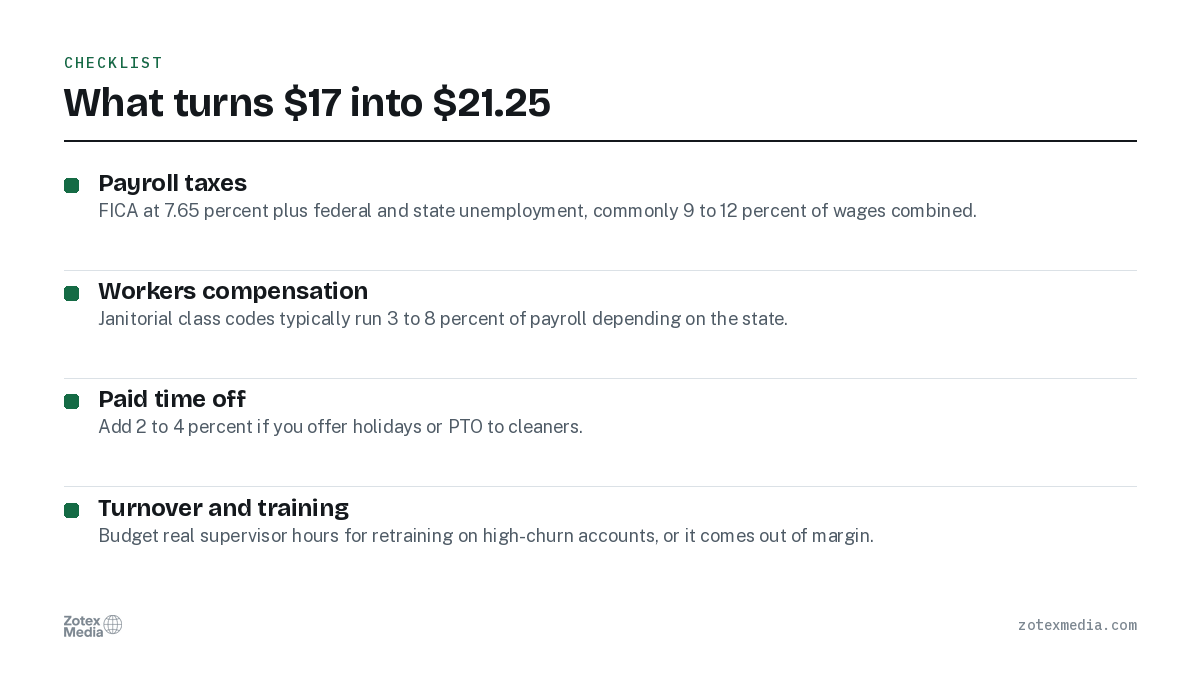
Median pay for janitors and cleaners runs around $17 an hour nationally according to BLS occupational data, with wide swings by metro. Your real cost is higher. Employers owe 7.65 percent for Social Security and Medicare on every wage dollar, per the IRS employer tax rates, before unemployment insurance, workers comp and any paid time off.
- Payroll taxes: FICA plus federal and state unemployment, commonly 9 to 12 percent of wages combined.
- Workers compensation: janitorial class codes typically run 3 to 8 percent of payroll depending on the state.
- Paid time off and holidays: add 2 to 4 percent if you offer them.
- Training and turnover: put a real number on it. High-churn accounts cost supervisor hours every month.
Stack those and your burden multiplier lands between 1.18 and 1.32. Use 1.25 until you calculate your own. At $17 an hour base, that is $21.25 per loaded labor hour.
Convert weekly visits to monthly hours correctly
Weekly frequency times 52, divided by 12. Five nights a week is 21.7 visits a month, three nights is 13.0, seven days is 30.3. Bidding 20 visits for five-night service gives away about 8 percent of your labor, every year, forever.
Supplies, equipment and overhead need their own lines
These costs are small one at a time and fatal together. Keep them separate so you know exactly what you are surrendering when the buyer pushes on price.
- Chemicals and liners: usually 2 to 4 percent of contract revenue for standard office work.
- Paper and soap: quote as a pass-through line at a per-case price. Consumption moves with headcount, and that is not a risk you should eat.
- Equipment: vacuums, burnisher, auto-scrubber. Spread the purchase across its useful life and charge the account its monthly share.
- Vehicle and fuel: real money on a route with six stops a night.
- Overhead: office, insurance, software, admin pay, your salary. Most companies under $5M land at 12 to 20 percent of revenue.
- Net profit: target 10 to 18 percent on recurring janitorial. Periodic and specialty work carries more.
Price with a divisor, not a markup. If overhead is 15 percent and target net is 12 percent, divide direct cost by 0.73. Marking direct cost up by 27 percent produces a smaller number and a thinner margin than you think you set.
A worked example: 20,000 square feet, five nights a week
Class B office, 20,000 cleanable square feet, 90 employees, centralized trash. Floor mix: 13,000 open office carpet, 3,500 private offices and conference rooms, 2,500 hard floor corridors and breakroom, 1,000 in four restrooms with four fixtures each.
Step one: hours per visit
- Open office carpet: 13,000 at 4,200 sq ft per hour = 3.10 hours
- Private offices and conference: 3,500 at 2,800 sq ft per hour = 1.25 hours
- Hard floor: 2,500 at 6,000 sq ft per hour = 0.42 hours
- Restrooms: 4 rooms at 18 minutes = 1.20 hours
- Setup, lockup, trash haul: 0.30 hours
Total is 6.27 hours. Call it 6.25 per visit. Blended, that is 3,200 square feet per labor hour, right in the middle of the sanity range.
Step two: cost build-up to a price
| Line | Math | Monthly |
|---|---|---|
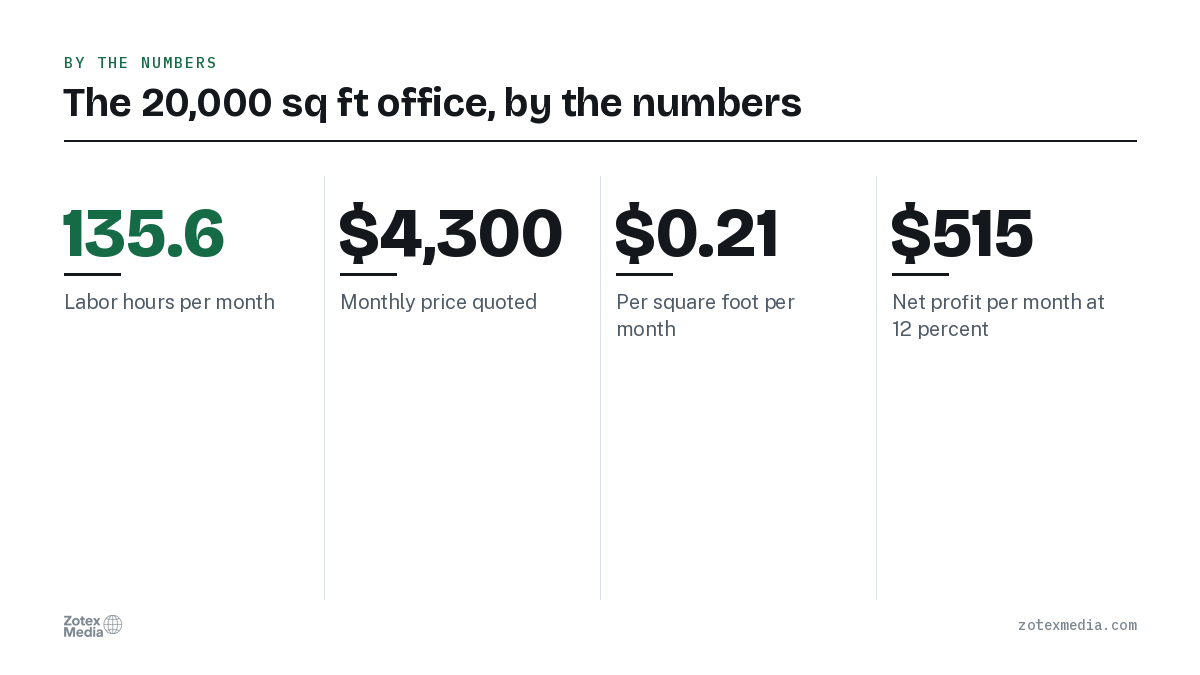
| Labor hours | 6.25 hrs x 21.7 visits | 135.6 hours |
| Direct labor | 135.6 hrs x $21.25 loaded | $2,882 |
| Chemicals and liners | Estimated | $150 |
| Equipment and vehicle | Allocated | $100 |
| Total direct cost | Sum | $3,132 |
| Price at 15% overhead, 12% net | $3,132 / 0.73 | $4,290 |
Quote $4,300 a month. That is $198 per visit, about $32 per billable hour, and $0.21 per square foot per month, with an annual value of $51,600 and roughly $515 a month in net profit.
Now you can see your discount room. Cut the price 10 percent to $3,861 and your direct cost does not move, so net profit falls from about $515 to about $150 a month. A 10 percent discount costs you 71 percent of the profit. If filling your calendar with buildings this size is the real constraint, book a free strategy call and we will map what qualified pipeline costs in your market.
Present three tiers so the buyer picks a level
One price makes it yes or no. Three prices make it which one. Build every tier off the same cost model so all three are profitable.
| Tier | Scope | Monthly | Best fit |
|---|---|---|---|
| Essential | 3 nights a week, 6.75 hrs per visit | $2,850 | Tight budget, lower traffic |
| Standard | 5 nights a week, 6.25 hrs per visit | $4,300 | Most Class B offices |
| Premium | 5 nights plus a 4 hour day porter | $6,900 | Client-facing lobbies, heavy traffic |
Three-night service takes longer per visit because soil load builds between cleanings, so do not just multiply the five-night price by 0.6. The porter in the Premium tier is 86.8 hours a month at the same loaded wage, which is why it adds roughly $2,600 and not a token fee.
Price periodics separately and show them as a dated schedule: carpet extraction, strip and wax, scrub and recoat, high dusting, interior windows, upholstery. Burying them in the monthly rate hides your margin and makes your base number look expensive next to a competitor who excluded them.
"All three options cover the same scope of work. The only difference is how many nights we are in the building and whether you want someone here during the day. Most buildings your size with your traffic go with the five-night option. Which one fits the budget you were given?"
Put the scope in writing with a room-by-room task list and a frequency column. The free commercial cleaning proposal template handles the format, and attaching the quality control inspection checklist you will score the account against separates you from the two-page competitors. Include a 3 to 5 percent annual escalation and a 30 day cancellation window, both covered in the guide to structuring contracts for profit, then plan the first 90 days using the steps for turning new accounts into long-term contracts.
Where commercial cleaning bids and RFPs get posted
Most private contracts are never posted. They change hands because someone called the facility manager in the month the contract came up for renewal. Public work is the opposite: posted, scored and slow.
- Federal: solicitations are listed on SAM.gov, and you need an active registration and a UEI before you can submit.
- State and local: every state runs a procurement portal, and aggregators like BidNet Direct carry county and municipal work.
- School districts: posted on district business office pages, usually bid in spring for an August start. See the schools and daycare playbook.
- Property management firms: no portal exists. You get on the list by calling the property manager.
Before you spend a day on an RFP, check three things: insurance limits, bonding requirements, and whether prevailing wage or Service Contract Act wage determinations apply. A wage determination can push labor well above your private rate, and bidding it at your normal wage means winning a job you lose money on for five years. If the scope touches healthcare or school health rooms, price in the training and PPE required by the OSHA bloodborne pathogens standard.
Sealed bids and walkthroughs are different games. On a sealed bid you compete on price against everyone who showed up. On a walkthrough you compete on trust against the two other companies who got invited, which is the dynamic behind the office cleaning contracts playbook and the warehouse and industrial playbook.
Common mistakes
- Using gross square footage. Cleanable area is often 10 to 20 percent below the number on the lease. Measure it yourself.
- Bidding 20 visits a month for five-night service. The real figure is 21.7, so you just handed over 20 free cleanings a year.
- Pricing off a base wage. At a 1.25 burden, quoting from $17 instead of $21.25 deletes your margin before you add a single case of liners.
- Hiding periodic floor work in the monthly rate. Strip and wax inside a flat fee turns a good account bad the first time they ask for it quarterly.
- No escalation clause. Wages rise every year. A flat three-year price ends at a materially worse margin than it started.
- Discounting instead of cutting frequency. If the budget is $3,000, sell the three-night tier. Dropping price without dropping scope teaches the buyer your first number was fiction.
One more: bidding everything. If you quote 20 buildings a month and close one, the issue is not your formula, it is who you are standing in front of. That is why commercial cleaning leads only count when the contact actually controls the cleaning decision, has a need, and agreed to a next step. Zotex charges a flat $200 per walkthrough-ready lead on that basis, and the pricing page spells out the three gates.
Frequently asked questions
How to bid a cleaning contract?
Measure cleanable square footage by floor type, count restroom fixtures, then convert area to labor hours with task-level production rates. Multiply hours by monthly visits and your loaded wage, add supplies and equipment, then divide the total by one minus your overhead and profit percentages. A 20,000 square foot office at five nights a week usually lands between $3,500 and $5,000 a month depending on local wages.
How to calculate a cleaning bid?
Work in this order: hours per visit, visits per month, loaded labor cost, other direct costs, then price. The worked example above is 6.25 hours x 21.7 visits = 135.6 hours, x $21.25 loaded = $2,882, plus $250 of supplies and equipment, divided by 0.73 for 15 percent overhead and 12 percent net, which is $4,290 a month. Round the final price, never the inputs.
How do I find commercial cleaning contracts?
Public work is posted on SAM.gov for federal, on state procurement portals, on aggregators like BidNet Direct, and on school district business pages. Private work is almost never posted, so it comes from direct outreach to facility managers, property managers and practice managers, or from referrals. Most companies under $5M win the majority of their accounts through outbound calls and email, not bid portals.
How do I start bidding commercial?
Start with 5,000 to 20,000 square foot buildings where one person signs, usually an office manager or a practice manager. Carry general liability and workers compensation first, because most buyers want a certificate of insurance naming them as additional insured before they sign. Bid five to ten of those a month, log why you lose each one, and correct your production rates with real timecard data after 90 days.
How to gain commercial cleaning clients?
Reach the decision-maker 60 to 90 days before their current contract renews and ask for a walkthrough instead of pitching a price. Follow up five to seven times across phone and email, since few buyers switch on first contact. Then keep the account by inspecting it monthly and sending the signed inspection report to the person who hired you.
Should I include paper products and soap in my bid?
Quote them as a separate pass-through line at a per-case price rather than inside the monthly rate. Consumption rises with headcount and visitor traffic, and neither is under your control. Clients who buy their own paper still expect you to stock the dispensers, so write that task into the scope either way.
Spend your week bidding, not prospecting
Book a free strategy call and see what it takes to put walkthrough-ready buildings in front of you every week, at a flat $200 per lead with no retainer.
Book Your Strategy Call