
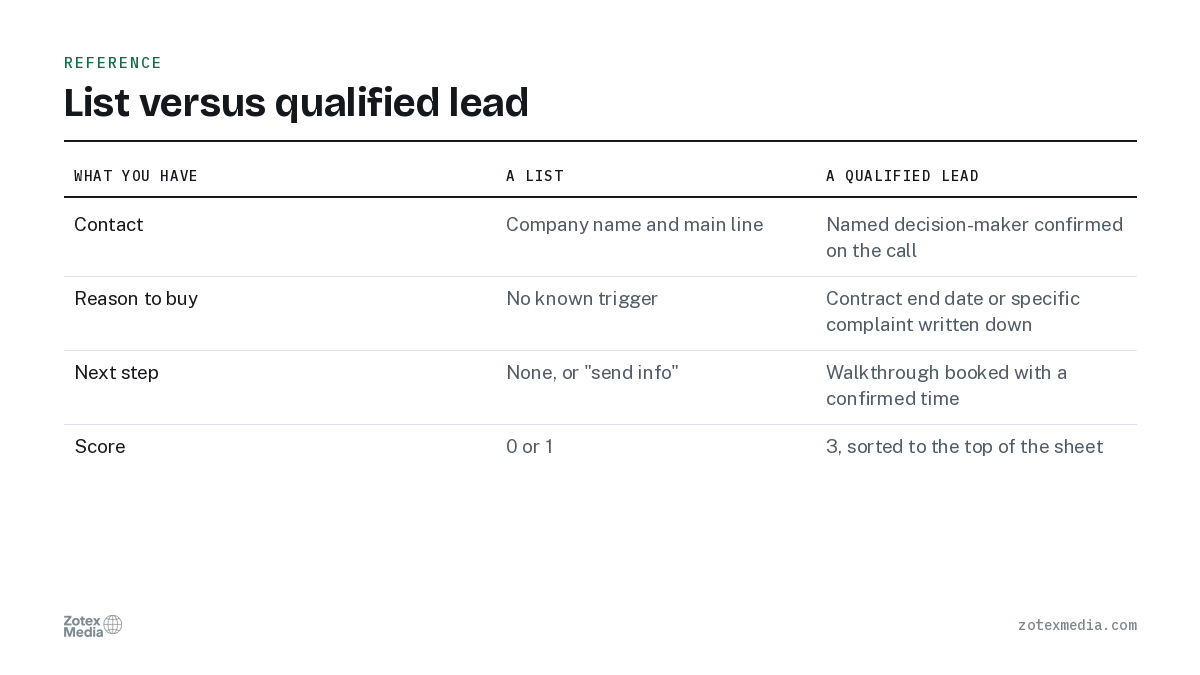
You paid for leads last month and got a spreadsheet of company names and switchboard numbers. Half the numbers were dead, and the two people who picked up are fine with their current cleaner. A qualified commercial cleaning lead clears three gates: the contact owns the cleaning decision, they have a need you can name in one sentence, and they agreed to a next step with a date on it. Two out of three gives you a list, not a lead.
What follows: what fails each gate, a scoring sheet you can build in 20 minutes, the arithmetic behind a $467 booked walkthrough, where qualified leads come from by contract type, and what to do with the near misses.
A qualified lead clears three gates, not two
Every lead source in this business, bought or built, can be judged with the same three questions.
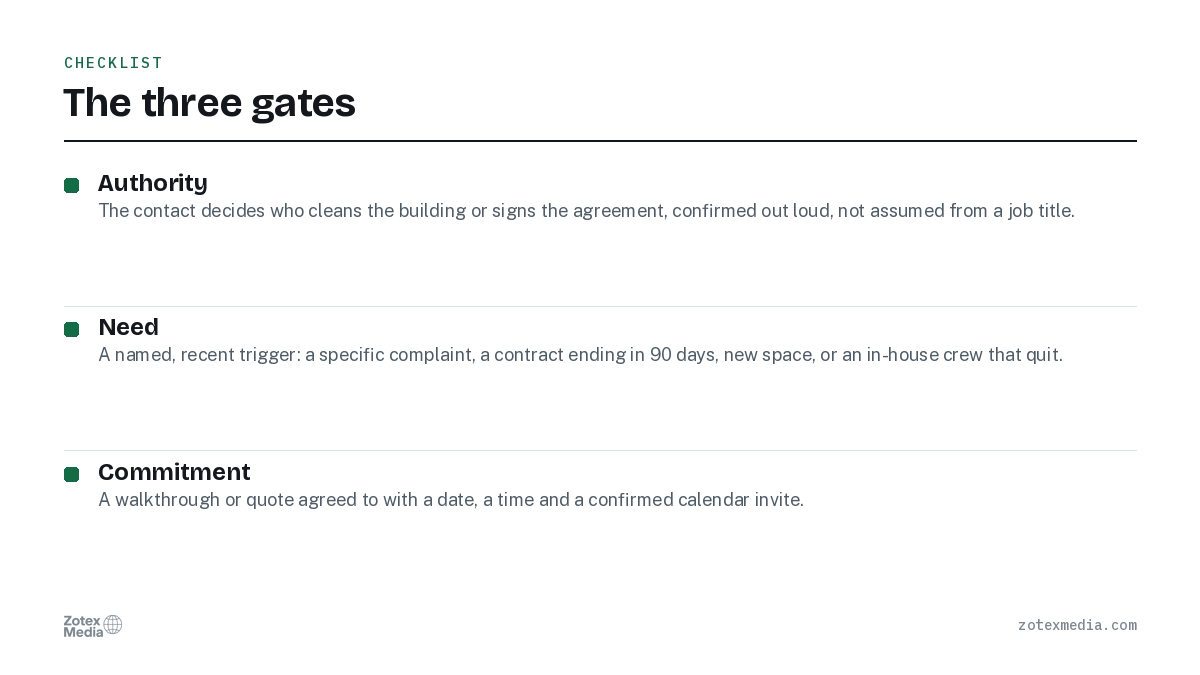
- Gate 1, authority. This person decides who cleans the building or signs the agreement. Not the person who forwards your email to them.
- Gate 2, need. Something changed: unhappy with the incumbent, new space, a contract ending, an in-house crew that quit.
- Gate 3, commitment. They said yes to a walkthrough or a quote, with a date, a time and a name attached.
Two out of three feels productive and moves no revenue. A facility manager who hates her current cleaner but will not give you 20 minutes is a follow-up task. A decision-maker who books a walkthrough with no problem to solve is collecting a third bid for the incumbent.
Use the same standard whether you buy commercial cleaning leads or generate them with your own callers. Write the three gates on a sticky note and put it on the monitor of whoever books your appointments.
Gate 1: the contact owns the cleaning decision
This gate kills more pipeline than the other two combined, because cleaning sits in a different spot on every org chart. In a 6,000 square foot insurance office, the office manager who orders the coffee also picks the cleaner. In a 200,000 square foot campus, a facility manager owns a budget line and a bid process.
Who signs, by facility type and size
| Facility and size | Title that signs | Common dead end |
|---|---|---|
| Office suite under 15,000 sq ft | Owner or office manager | Receptionist or office coordinator |
| Office building 50,000 sq ft and up | Facility manager or director of facilities | Building engineer |
| Multi-tenant property | Property manager at the management company | Individual tenants |
| Medical or dental practice | Practice manager or office administrator | Front desk staff |
| School or daycare | Business manager, director of operations, or center director | Principal's assistant |
| Warehouse or plant | Plant manager or EHS manager | Shipping supervisor |
| Multi-site chain or franchise | Procurement or category manager at corporate | Store or branch manager |
Titles shift by vertical, which is why the facility-type playbooks break them out one at a time. If you sell mostly office space, memorize the buyer map in the guide to office cleaning contracts first. Medical works differently, since a dental or medical practice manager answers to a doctor who signs but does not shop.
What fails this gate
- The forwarder. "Send it over and I will pass it along." You never learn who read it, or whether anyone did.
- The tenant instead of the landlord. In multi-tenant buildings, common areas belong to the property manager, not the business on floor three.
- The regional who is not regional. A district manager two states away who says "corporate handles that."
- The relative. The owner's brother-in-law cleans the place on weekends. There is no contract to win.
One question fixes most of this, and it belongs in your first two minutes:
"If you decided tomorrow to change cleaning companies, whose signature goes on the agreement?"
It costs you nothing and saves an hour of proposal work. If the answer is a name you have not spoken to, you have a referral to chase, not a lead to book.
Gate 2: there is a named need with a date
Need is not "they have a building and buildings get dirty." Need is a recent, specific event. If your setter cannot write it in one short sentence, the gate did not pass.
Triggers that count
- A named complaint about the incumbent. "Restrooms get missed on Fridays." "They went through three crews in six months."
- A contract ending in 90 days or less. Ask for the end date and the notice period. Most commercial agreements run 12 months with a 30 day out.
- New or expanded space. A move, a second location, a buildout finishing next quarter.
- An in-house team failing. The custodian retired, or they cannot keep the position filled.
- A failed inspection or audit. Common in medical, food handling and manufacturing.
What fails this gate
"Send me a quote for our files" is the most expensive sentence in this business. "We might look at this next year" is second. Both feel like progress and both produce a proposal nobody reads.
Watch for the third-bid problem too, since plenty of buyers need three quotes to justify keeping the vendor they already like. Ask it straight:
"Is this a comparison for budget purposes, or are you actually planning to make a change?"
Most people will tell you the truth. The ones who dodge the question just answered it.
When the trigger is a quality complaint, build the walkthrough around standards instead of price. Walk in with a room-by-room QC inspection checklist and ask them to grade their current vendor. That turns a vague gripe into a documented gap you can bid against.
Gate 3: they agreed to a dated next step
Interest is not commitment. Commitment has a date, a time, a place and a name. "Thursday at 9, I will meet you at the lobby desk" is a lead. "Sounds good, email me some info" is not.
The close is three sentences on the phone:
"Makes sense. The only way I can give you a real number instead of a guess is to see the space. I am out that way Thursday morning: does 9 or 10:30 work better? It takes about 20 minutes and you get the scope and price within 48 hours."
Two time options, a stated length, a promised deliverable. If you want more of these word for word, the free cold call scripts and objection handlers cover the gatekeeper, the voicemail and the six objections you hear most.
Two things fail this gate quietly. The soft yes with no date, where "sure, sometime next week" gets logged as booked. And the walkthrough nobody confirmed: send the calendar invite within five minutes of hanging up, then confirm by text the day before, because unconfirmed visits are where most no-shows come from.
Price the job roughly before you drive out. Run the square footage and frequency through the service pricing calculator and you can give a live range on site instead of going dark for a week.
Run the math: $467 per booked walkthrough
This matters for money, not vocabulary. Here is one month of self-generated outbound in round numbers.
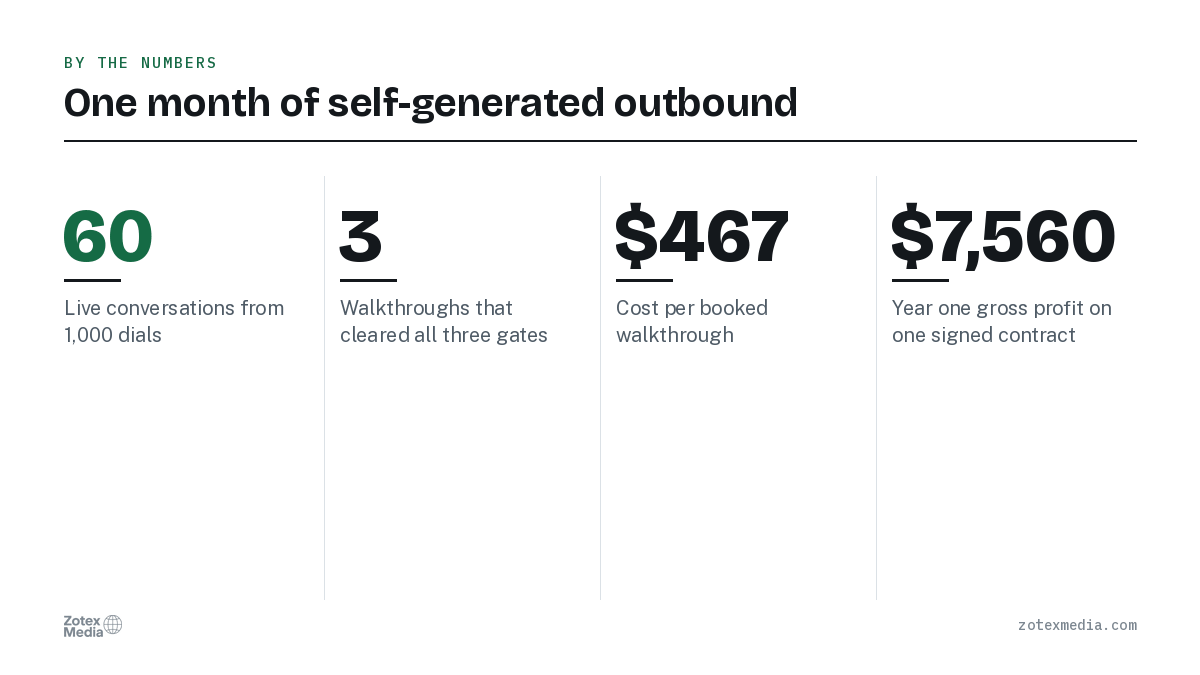
- List cost: 1,000 verified contacts at $0.20 each = $200.
- Dialing time: 25 dials per hour, so 1,000 dials = 40 hours. At $30 per hour loaded for a part-time setter, that is $1,200.
- Conversations: a 6% connect rate = 60 live conversations.
- Gate 1 survivors: 1 in 3 is the actual cleaning decision-maker = 20.
- Gate 2 survivors: 30% have a real, dated need = 6.
- Gate 3 survivors: half agree to a walkthrough = 3.
Total spend: $1,400 for 3 booked walkthroughs, or $467 per walkthrough. Close one of the three at $1,800 a month and that is $21,600 in year-one revenue. Janitors and building cleaners earn a median wage near $17 an hour nationally according to the Bureau of Labor Statistics, and once you add payroll taxes, insurance, supplies and supervision, most operators we talk to run 55% to 70% of contract revenue in direct cost. At a 35% gross margin, that contract throws off $7,560 in gross profit against $1,400 of acquisition cost.
That is a good trade, so the lesson is not that outbound is expensive. The lesson is to know your number. If you are paying $467 per walkthrough and your list fails Gate 1 half the time, the fix is qualification, not more dialing. For a benchmark to measure your own setters against, Zotex charges a flat $225 per qualified walkthrough with no retainer, which is spelled out on the pricing page.
Score every lead 0 to 3 in a spreadsheet
You do not need a CRM for this. You need nine columns and the discipline to fill them in the same day.
- Build the columns. Company, contact name, title, Gate 1 (0 or 1), Gate 2 (0 or 1), Gate 3 (0 or 1), score, next action date, notes.
- Score Gate 1 on evidence. A 1 means the contact said out loud that they decide or sign. A title alone is a 0.
- Score Gate 2 with a sentence. Empty notes cell, gate is 0. "Contract with current vendor ends March 31" is a 1.
- Score Gate 3 with a date. No date on the calendar, no point.
- Sort by score, descending. Only 3s get windshield time. 2s get a call this week. 1s get a useful email every 45 days. 0s get deleted.
- Review for 15 minutes every Friday. Count the 3s you created that week. That number predicts next quarter better than this month's revenue does.
After a month, one gate will be failing far more than the others. If Gate 1 fails most, your list or your research is wrong. If Gate 2 fails most, your targeting is fine and your timing is random. If Gate 3 fails most, your ask is weak and the script is the problem.
If you want a second opinion on your thresholds, bring your last 30 leads to a free strategy call and mark which gate each one failed.
Where qualified leads come from, by contract type
The US janitorial services industry runs north of $100 billion in annual revenue according to IBISWorld, so scarcity is not your problem. Access to the right contact at the right moment is, and different contract types live in different places.
| Contract type | Typical monthly value | Typical frequency | Where the leads come from |
|---|---|---|---|
| Small office suite (under 10,000 sq ft) | $400 to $1,200 | 2 to 3 nights a week | Cold calling, referrals, drive-by canvassing |
| Multi-tenant office building | $2,500 to $9,000 | 5 nights a week | Property management companies, BOMA chapters |
| Medical or dental practice | $800 to $2,500 | 3 to 5 nights a week | Outbound to practice managers, dental society lists |
| School or daycare | $1,500 to $8,000 | 5 nights a week plus summer deep clean | District RFPs, state bid portals, BidNet |
| Warehouse or light industrial | $1,500 to $12,000 | Daily or shift-based | Plant manager outbound, industrial park canvassing |
| Government or federal facility | $3,000 to $40,000 | Daily | SAM.gov, state and county procurement portals |
Those bands reflect what we see in mid-size US and Canadian metros, and they move with local wages, so a band that fits a low-cost metro runs high on the coasts. Facility counts by type and metro sit in the market-by-metro research if you are deciding where to point your callers. Dealership work is its own animal, and the buyer map for car dealership cleaning contracts runs through the GM or fixed ops director.
Bid portals clear Gate 2 and fail Gate 1
A posted RFP means a real need with a real date, so Gate 2 is automatic. Gate 1 usually fails in the way that matters, because you rarely get a conversation with the decision-maker before the award. Expect low win rates and long cycles, and treat portals as a supplement instead of a pipeline. For school and daycare contracts, the portal route is often unavoidable. For warehouse and industrial work, direct outreach to the plant manager usually beats waiting for a posting.
Outbound is the only source you control
Referrals are the highest quality and the least controllable. Ads produce volume with poor Gate 1 rates, since the person filling in a form is often researching rather than buying. Outbound email and phone is the one channel where you pick the building, the title and the timing, which is the model behind how Zotex qualifies a walkthrough and also what a good in-house setter does. To compare channels side by side, the rundown of five ways to get more commercial cleaning leads covers the trade-offs.
Change the next action when a gate fails
A failed gate is not a reason to delete the record. It is a reason to change the next action. Sort your near misses by which gate broke.
- Failed Gate 1 (wrong person). Get the right name before you hang up: "Who handles the cleaning contract, and what is the best way to reach them?" Then call back and use the referral by name.
- Failed Gate 2 (no need yet). Get the contract end date and set a reminder for 120 days before it. Email quarterly with something short and useful, never "just checking in."
- Failed Gate 3 (no commitment). Offer something smaller: a 10 minute call, or a one-page scope built from public square footage. Send the proposal template only after they engage.
A decision-maker with no need today is worth more than a stranger with an urgent one. Keep them in the sheet with a date, because most of the contracts you sign next year come from people who told you no this year. Once they sign, the work shifts to keeping them, which is the subject of turning one-time clients into long-term contracts.
Common mistakes
- Counting form fills as leads. An inbound form from an unnamed "office manager" at a building you cannot identify fails Gate 1 until proven otherwise. Call within five minutes and qualify before you quote.
- Quoting before the walkthrough. A price without a site visit is a guess, and guesses get shopped. Hold the number until you have seen the restrooms and the floor types.
- Buying appointments that are not gated. Some sellers count "yes, send information" as a booked appointment. Ask any vendor which three things must be true before they bill you, and what happens when a walkthrough is bad.
- Letting a 3 go cold. A qualified lead has a shelf life of about two weeks. If the walkthrough slips twice, re-qualify from scratch instead of chasing.
- Skipping the close on site. You cleared all three gates, then left without asking for a start date. The guide to closing commercial cleaning deals covers the on-site ask.
- Judging a source on one month. At 3 walkthroughs a month and a one-in-three close rate, a slow month proves nothing. Judge any channel on 10 to 15 walkthroughs.
Frequently asked questions
How to find commercial cleaning leads?
Pick one facility type, build a list of 300 to 500 buildings inside a 30 minute drive, and find the named decision-maker for each. Then work the list by phone and email until you have spoken with 20% of them. Bid portals like SAM.gov and state procurement sites add volume, but they rarely let you talk to the buyer before the award.
How do I get clients for my commercial cleaning business?
Clients come from three places: referrals from current accounts, direct outbound to decision-makers, and bids. Referrals close fastest and you cannot control the volume, so most operators doing $200k to $5M run a weekly rhythm of 200 to 400 dials. Expect roughly 3 booked walkthroughs per 1,000 dials and a close rate near one in three.
How do cleaning companies get leads?
Most come from cold calling and cold email to facility managers, property managers and practice managers, plus referrals and a small share from search ads. Ads bring volume with weak qualification, since form fillers are often comparison shopping. Outbound is the only channel where you choose the building, the title and the timing.
How do I find commercial cleaning contracts?
For private buildings, go direct to the title that signs: office manager under 15,000 sq ft, facility manager above 50,000 sq ft, property manager for multi-tenant. For public work, watch SAM.gov for federal, plus BidNet and your state or county portal for schools and municipal buildings. Ask every private prospect when their agreement ends, then call back 120 days before that date.
What is a good way to generate leads for commercial cleaning services?
Targeted outbound to a short list, scored against three gates: decision-maker, real need, agreed next step. Working 300 well-researched contacts beats blasting 3,000 unverified ones, because the failure point is almost always Gate 1. Track how many leads reach a score of 3 each week and grow that number instead of your dial count.
How many leads does it take to land one commercial cleaning contract?
In the example above, 1,000 dials produced 60 conversations, 20 decision-makers, 6 with a real need and 3 booked walkthroughs. At a one-in-three close rate that is one contract per 1,000 dials, at about $1,400 in cost or $467 per walkthrough. Measure your own ratios for 90 days before judging any channel.
Want walkthroughs that clear all three gates
Book a free strategy call. We will look at your last 30 leads, mark which gate each one failed, and show you what qualified pipeline looks like in your market.
Book Your Strategy Call