You have a walkthrough Thursday and no real idea whether $0.12 a square foot is fair or a two-year mistake. Per square foot is the most common shortcut in janitorial and the most common way to underbid. Most recurring commercial cleaning work prices between $0.10 and $0.30 per square foot per month, or $28 to $45 per billable labor hour, depending on facility type and frequency. Below: the ranges by facility type, the production rates that produce them, two worked examples carried to a final monthly number, an add-on price list, and what to say when the buyer pushes back.
Headline ranges: $0.10 to $0.26 per square foot for offices
These are the quote ranges we see across independent cleaning companies and franchise owners in US and Canadian metros. They are not published statistics. Treat them as a sanity check on your own math, not a substitute for it.
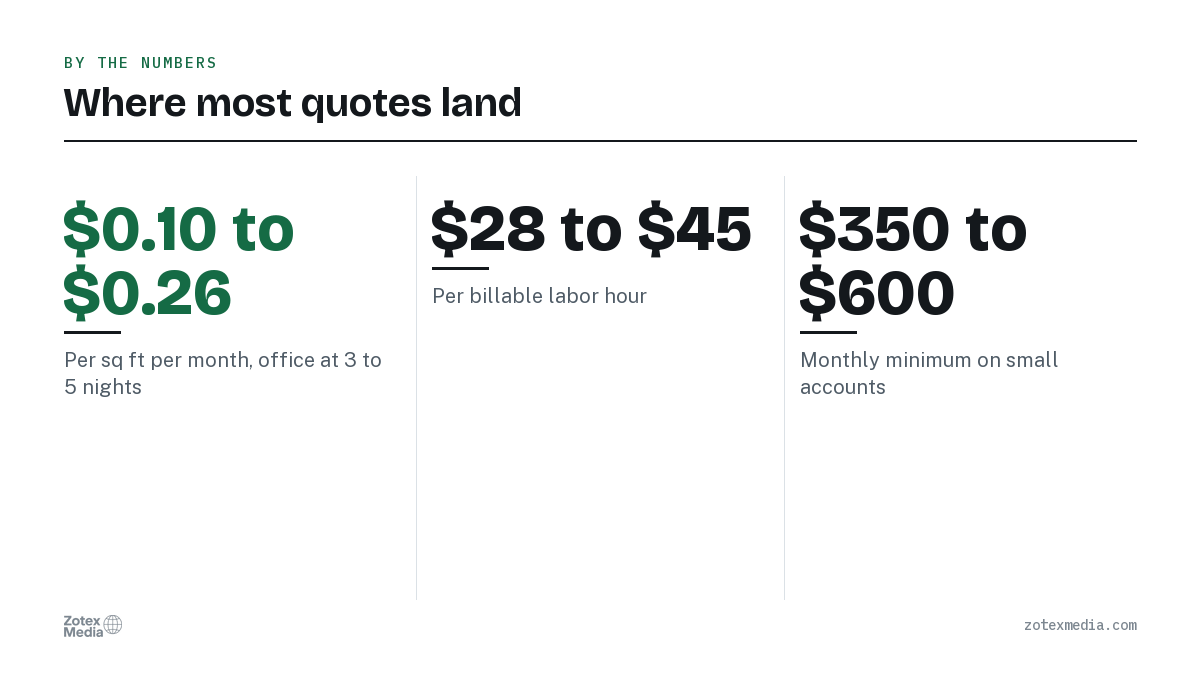
- Per square foot per month: $0.10 to $0.26 for general office at 3 to 5 nights a week. Medical and fitness run higher. Warehouse runs far lower.
- Per billable labor hour: $28 to $38 in most mid-size markets, $38 to $50 in high cost metros and for medical or union work.
- Monthly minimum: $350 to $600 on any account, no matter how small the floor plan.
- One-time and project work: $0.10 to $0.50 per square foot, priced as a separate line, never folded into the monthly.
High cost metros run about a quarter above the middle of these ranges, and almost all of that gap is wages and drive time. Canadian accounts follow the same structure in Canadian dollars, so do not convert a US rate card and hope. Before you set a rate card in a new market, the metro research on commercial facilities by type shows what mix of buildings you will actually be quoting.
Per square foot is an output, not an input
No building costs more because it has more square feet. It costs more because more square feet takes more labor hours, and labor is the biggest line on almost every account. The per square foot figure is what falls out at the end, after you have priced the hours.
Four inputs produce every price:
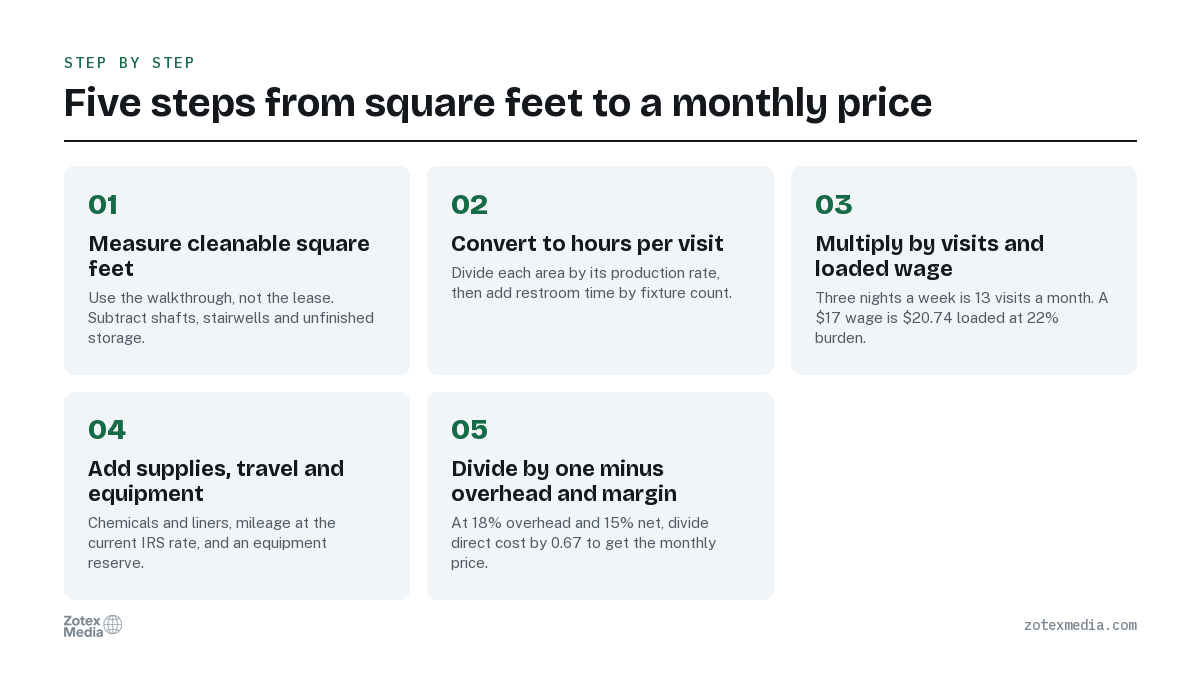
- Cleanable square footage. Not the lease number. Subtract elevator shafts, stairwells you do not touch, and unfinished storage.
- Production rate. Square feet one cleaner covers in one hour at the scope you agreed to.
- Frequency. Visits per month, not per week. Three nights a week is 13 visits a month, five nights is about 22.
- Loaded wage. Hourly wage plus payroll burden, never the wage alone.
The chain is short: square feet ÷ production rate = hours per visit. Hours per visit × visits per month × loaded wage = monthly labor cost. Add supplies, travel and equipment, then divide the total by one minus your overhead and margin percentages. The free square footage and frequency calculator runs that chain if you would rather not build the spreadsheet.
Use your own overhead percentage, not somebody else's. Add up last year's insurance, vehicles, admin pay, software, office and phone, then divide by revenue. The owners we talk to usually land between 12% and 22%. If you have never run that number, use 18% today and correct it after your next tax return.
Production rates decide the price: square feet per labor hour
Production rates are the number most owners guess at, and the guess is usually about 20% optimistic. ISSA publishes cleaning times used across the industry, and they are worth owning if you bid often. The table below is the practical working range for light nightly service: trash, restrooms, spot mopping, vacuuming traffic lanes, and dusting on a rotation.
| Space type | Sq ft per cleaner hour | What pushes it to the low end |
|---|---|---|
| Open plan office | 3,200 to 4,500 | Desk clutter, carpet tile, trash at every desk |
| Private office and cubicle heavy | 2,400 to 3,200 | Door count, individual cans, hard floor |
| Medical or dental treatment areas | 1,200 to 2,000 | Operatory protocol, dwell times, high touch disinfection |
| Retail sales floor | 3,500 to 5,000 | Fixtures, fitting rooms, entry glass |
| K-12 classrooms | 2,500 to 3,500 | Desk wipe-down, chair stacking, sticky floors |
| Warehouse open floor, auto scrubber | 15,000 to 30,000 | Racking, pallet obstruction, dock debris |
Restrooms do not follow square footage. Budget 20 to 30 minutes per two fixture restroom, plus 6 to 10 minutes per additional fixture, and add that on top of the floor math. Get it wrong and the whole quote is wrong, because restrooms are where complaints start.
Replace this table with your own numbers as soon as you can. Time one cleaner in three buildings for two weeks, divide square feet by clock hours, and you have rates that match your crews and your standard. Facility-specific rates and scope items sit inside each of the nine facility type playbooks.
Price per square foot by facility type
Here is where the hours land once you convert them to a monthly number. Frequency moves the rate more than facility type does, so the frequency column is not decoration.
| Facility type | Typical frequency | $ per sq ft per month | Main cost driver |
|---|---|---|---|
| General office, 10,000 sq ft and up | 3 nights a week | $0.10 to $0.20 | Open floor ratio, restroom fixture count |
| General office, 10,000 sq ft and up | 5 nights a week | $0.15 to $0.26 | Same, plus daily restroom resets |
| Medical or dental office | 5 nights a week | $0.30 to $0.60 | Operatory count, disinfection protocol |
| Retail storefront | 5 to 7 days a week | $0.15 to $0.35 | Entry glass, floor type, foot traffic |
| School or daycare | 5 nights a week | $0.12 to $0.25 | Classroom count, restroom fixtures |
| Gym or fitness center | 7 days a week | $0.20 to $0.45 | Locker rooms, showers, equipment wipe-down |
| Car dealership | 5 to 6 days a week | $0.15 to $0.30 | Showroom glass, service bay grime |
| Church or place of worship | 1 to 2 days a week | $0.04 to $0.09 | Event schedule, sanctuary seating |
| Warehouse, 90% open floor | 3 nights a week | $0.02 to $0.06 | Scrubber access, office and restroom block |
Two notes on the spread. Medical looks expensive per foot until you price the hours: slow production rates on small footprints do that, and the medical and dental playbook covers the compliance items that justify it. Warehouse looks cheap per foot and can still be your best hourly margin, because a scrubber covers ground fast (warehouse and industrial playbook, gym and fitness playbook).
Know who reads the number. Offices under roughly 15,000 sq ft go through the office manager or the GM, larger buildings through the facility manager, multi-tenant properties through the property manager, dental and medical suites through the practice manager, and chains or school districts through procurement. Facility managers and procurement compare per square foot across bidders. Office managers and practice managers compare the monthly invoice, so lead with the monthly number there.
Two worked examples, start to finish
Both examples use a $17 base wage, near the national median for janitors and cleaners in BLS occupational data, plus 22% payroll burden for FICA, unemployment and workers comp. Add health benefits and burden climbs: BLS employer cost data puts benefits near 30% of total compensation in private industry. Vehicle cost uses about 70 cents a mile, so check the current IRS standard mileage rate before you copy it. Swap in your own wage and the rest of the math holds.
Example 1: 12,000 sq ft office, 3 nights a week
The walkthrough finds 8,400 sq ft of open plan, 2,400 sq ft of private offices and conference rooms, a 400 sq ft break room, two restrooms with eight fixtures total, and a glass entry.
- Open plan: 8,400 ÷ 3,500 = 2.40 hours
- Private offices: 2,400 ÷ 2,500 = 0.96 hours
- Break room: 0.25 hours
- Restrooms: 0.75 hours
- Entry glass and misc: 0.15 hours
That is 4.51 hours per visit, call it 4.5. At 13 visits a month you need 59 labor hours. Loaded wage is $17 × 1.22 = $20.74, so labor is 59 × $20.74 = $1,224. Add $90 in chemicals and liners, $110 in vehicle cost (13 visits × 12 miles × $0.70), and a $50 equipment reserve. Direct cost is $1,474.
Now price it. At 18% overhead and a 15% net target, divide $1,474 by 0.67. That is $2,200 a month, $169 a visit, and $0.18 per square foot per month. Your effective bill rate is $37 an hour, which is the second check worth running. Proof: $2,200 minus $1,474 direct minus $396 overhead leaves $330 net, exactly 15%.
Example 2: 5,000 sq ft dental practice, 5 nights a week
Ten operatories, reception and hallways, a lab, a sterilization room, two restrooms. Operatories run 6 minutes each for 1.0 hour total, front of house is 0.5 hours, restrooms 0.6, lab and sterile area 0.3, trash and mop consolidation 0.6. Three hours per visit.
At 22 visits a month that is 66 hours. Medical pays better, so use an $18.50 wage at 24% burden: $22.94 loaded, or $1,514 in labor. Add $110 for EPA-registered disinfectant and liners, $123 in vehicle cost, and $40 a month for bloodborne pathogens training and PPE. Direct cost is $1,787.
Divide by 0.67 again and you get $2,667. Quote $2,700 a month: $123 a visit and $0.54 per square foot per month. That number scares owners who only bid offices, and it is exactly why medical is worth chasing. If you want a second set of eyes on a quote before you send it, book a free strategy call and walk the math through with someone who prices these daily.
Why small buildings cost more per square foot
Drive time, setup, equipment unload, lock-up and paperwork do not shrink when the building does. A 2,000 sq ft suite still eats about 25 minutes of non-cleaning time per visit. Spread over 2,000 feet that is brutal. Spread over 40,000 feet it disappears.
| Building size | Typical monthly, office at 3 nights | Effective $ per sq ft per month | What drives the gap |
|---|---|---|---|
| Under 3,000 sq ft | $350 to $700 | $0.14 to $0.28 | Minimum charge, travel per visit |
| 3,000 to 10,000 sq ft | $600 to $1,600 | $0.11 to $0.22 | One cleaner, fixed setup and lock-up |
| 10,000 to 25,000 sq ft | $1,300 to $3,200 | $0.10 to $0.16 | Route efficiency starts to pay |
| 25,000 to 75,000 sq ft | $2,800 to $8,500 | $0.09 to $0.14 | Team cleaning, riding equipment |
| 75,000 sq ft and up | $8,000 to $25,000 | $0.07 to $0.12 | Supervisor load, day porter coverage |
Effective rates are calculated at the midpoint of each band. The rule: never quote a small suite off a rate card. Quote the hours, then apply your minimum.
A $350 to $600 monthly floor is normal and defensible. The buyer on a small suite is usually the office manager or the owner, and the line that lands is simple: "Below about 3,000 feet my cost is drive time and setup, not square footage, so I price a minimum instead of a rate."
Price add-ons and periodic work on separate lines
Folding floor work into the monthly rate is how you end up stripping and waxing for free in year two. Put periodic services on their own line with their own frequency and let the buyer choose. It also gives you something to sell later, which is the point of turning one-time work into recurring contracts.
| Service | Typical price | Minimum | Note |
|---|---|---|---|
| Hot water carpet extraction | $0.15 to $0.35 per sq ft | $250 | Encapsulation runs $0.10 to $0.20 |
| Strip and wax VCT | $0.45 to $0.95 per sq ft | $400 | Scrub and recoat is $0.20 to $0.40 |
| Buff or burnish hard floor | $0.06 to $0.15 per sq ft | $200 | Quarterly works for most offices |
| Interior glass and partitions | $2 to $6 per pane | $150 | Exterior ground level runs higher |
| Pressure washing walks and pads | $0.15 to $0.40 per sq ft | $250 | Check water source and runoff rules |
| Post-construction final clean | $0.20 to $0.50 per sq ft | $500 | Rough clean is $0.10 to $0.25 |
| Day porter | $25 to $40 per hour billed | 4 hours per day | Bill separate from the night rate |
| Consumables supply | Cost plus 25% to 40% | None | Or pass through at cost with a handling fee |
If the buyer wants a level monthly invoice, price the periodic work for the year, divide by 12, and show it as its own line. You get predictable cash, they get no surprise invoices, and the base service rate stays visible. The free proposal template keeps base service and periodic work visibly separate, which prevents the "I thought that was included" conversation nine months in.
When to quote hourly or flat instead of per square foot
Per square foot works when the scope is predictable and repeated. When either breaks, change the unit or you eat the variance.
- Quote hourly for day porters, construction cleanup with no firm finish date, event turnarounds, and anything where the client controls how much mess appears.
- Quote flat per visit for churches and part-time facilities where the building gets used unevenly week to week.
- Quote per fixture or per room for medical suites and restroom-heavy buildings, then convert to a monthly number for the proposal.
- Quote per square foot for offices over 10,000 sq ft, schools, warehouses, and any RFP that demands a rate for comparison.
- Add a prevailing wage line on public work. Government and district bids set the wage floor, and your normal rate card will not survive it.
Procurement teams at chains and districts want a per square foot figure so they can line bidders up. Give it to them, but give it as a derived number at the bottom of a scope-based quote, not as the basis of the quote. The office cleaning playbook and the school and daycare playbook cover how each buyer group reads a bid sheet.
When a client asks for a lower price
Take the $2,200 office from Example 1. The facility manager says another bidder came in at $1,850 and asks you to match. Run it in front of them: $1,850 minus $1,474 direct cost minus $396 overhead leaves negative $20. A 16% discount does not trim your profit, it deletes it.
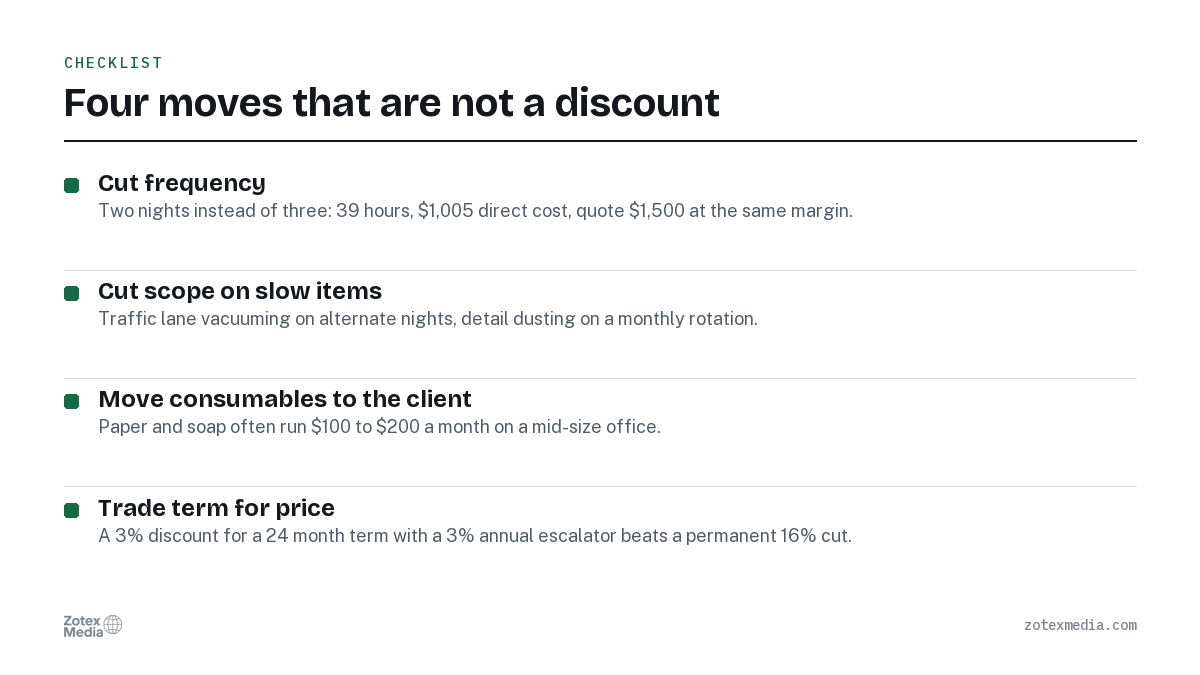
You have four honest moves, and none of them is dropping the rate:
- Cut frequency. Two nights instead of three: 39 hours, $1,005 direct, quote $1,500. Same margin, lower invoice, and the buyer picks the trade.
- Cut scope on the slow items. Vacuum traffic lanes only on alternate nights, or move detail dusting to a monthly rotation.
- Move consumables to the client. Paper and soap often run $100 to $200 a month on a mid-size office, and the buyer can source them through their own supplier.
- Trade term for price. A 3% discount for a 24 month term with a 3% annual escalator beats a permanent 16% cut. More on that in the guide to structuring contracts for profit.
Here is the language that works on a walkthrough:
"I can get to $1,850, but not at three nights. At that number I'd be cutting corners by month three and you'd be rebidding this in a year. Two nights a week at $1,500 gets you the same quality on the nights we're there. Or we stay at three nights and you supply the paper goods, which takes about $120 a month off my side. Which one fits your budget better?"
Say the number and stop talking. More responses like this live in the free objection handler library, and the walkthrough-to-close sequence is in the guide to closing commercial cleaning deals.
Common mistakes
- Pricing off a floor plan. A PDF will not show you carpet condition, restroom fixture count, or the state of the break room. Walk it, or add 15% for the unknown.
- Using the wage instead of the loaded wage. A $17 wage is $20.74 at 22% burden. On 59 hours a month that gap is $221, which was most of your profit.
- Charging by square foot on small suites. Anything under 3,000 sq ft needs a minimum, not a rate.
- No annual escalator. Wages move every year. Write a 3% to 4% annual increase into the agreement so you are not asking for a raise from scratch in month 13.
- Bidding without a scope document. If the scope is vague, every added task is free. Attach a room-by-room spec and use the QC inspection checklist as the standard you are both measured against.
- Chasing volume at 5% net. Three accounts at 18% beat six at 5% and take half the management. If the pipeline is the real problem, the guide to getting more commercial cleaning leads covers the channels that work.
Pricing discipline only pays off if you get enough at-bats to hold your number. Zotex Media generates commercial cleaning leads through outbound calls and email to facility decision-makers and charges $225 per qualified walkthrough with no retainer, so acquisition cost is a line you can drop straight into the math above.
Frequently asked questions
How much should I charge per square foot for commercial cleaning?
For general office at 3 to 5 nights a week, $0.10 to $0.26 per square foot per month covers most markets. Medical and dental run $0.30 to $0.60, gyms $0.20 to $0.45, warehouse space $0.02 to $0.06. Build the price from hours first and use the per square foot figure only as a check against these ranges.
How long does it take to clean a 5000 sq ft office?
Plan on 1.5 to 2.5 hours per visit for light nightly service with one cleaner. At 3,000 to 3,500 sq ft per hour you cover the floor in about 1.5 hours, then add 20 to 30 minutes per two fixture restroom. Add 30% if the space is cubicle heavy with a trash can at every desk.
What is the going rate per square foot for post construction cleaning?
Final cleans typically run $0.20 to $0.50 per square foot and rough or in-progress cleans $0.10 to $0.25. The spread is wide because dust load, window count and trash removal vary job to job. Set a $500 minimum, quote hourly when the GC cannot give you a firm finish date, and put change orders in writing.
Should I show my per square foot rate in the proposal?
Only if the buyer or the RFP asks for it. Leading with a rate invites a line-by-line comparison against bidders who scoped less work. Lead with the monthly price and the scope, then put the derived rate at the bottom for procurement teams who need it to compare across a chain.
How often should I raise prices on existing accounts?
Once a year, written into the agreement at 3% to 4%, effective on the contract anniversary. A scheduled escalator is a clause, not a negotiation. If you skipped the clause, ask at renewal with your wage numbers in hand.
Get walkthroughs worth pricing
Book a free strategy call and we'll talk through your numbers and whether qualified walkthroughs at $225 each make sense for your market.
Book Your Strategy Call