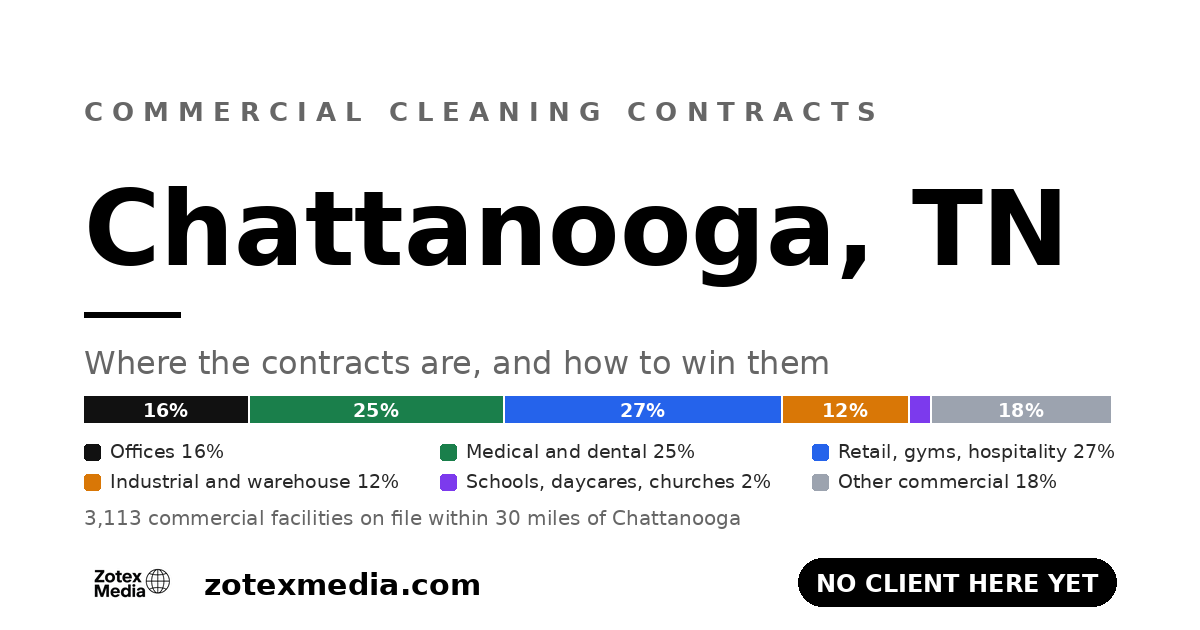
Commercial cleaning contracts in Chattanooga get won three ways, and the order matters. One: direct outbound by phone and email to the person who signs for cleaning at offices, clinics, warehouses and dealerships. Two: referral relationships through the Chattanooga Area Chamber, BNI chapters and the local facility management crowd. Three: public bids with the City of Chattanooga, Hamilton County, Hamilton County Schools, the State of Tennessee and UTC. Outbound is the only channel you fully control and the only one that can pay this quarter. Referrals pay best over time and take six to twelve months to warm up. Public bids are slow and price-driven, worth entering only on buildings you can staff tight and still clear margin on.
Where to spend your selling time in Chattanooga
If you need commercial cleaning accounts in the next 90 days, split your selling week like this.
- Outbound, about 60 percent. Dial and email facility managers, office managers, practice administrators and plant managers. It is the only channel where more effort reliably turns into more walkthroughs.
- Referral and relationship work, about 25 percent. Chamber councils, BNI, IFMA East Tennessee, plus property managers and general contractors who already trust you. Slow start, then it compounds.
- Public bids, about 15 percent. Register everywhere so you see the opportunities, then bid selectively. A bad number on a large building hurts for years.
Decide first which building types you can actually staff. A 40,000 square foot warehouse off Highway 153 and a surgical suite near Erlanger are different businesses. Pick two or three facility types and go deep. The facility-type playbooks break down how buying works for offices, medical, property management, warehouses and the rest.
Register once for city, county, school and state bids
Registration is free and takes an afternoon. Do it and the solicitations come to your inbox instead of you hunting for them.
City of Chattanooga
The city posts upcoming and open opportunities on its solicitation portal, including Requests for Quotes under $25,000 and sealed solicitations (Invitations to Bid, RFPs, RFQs). Purchases between $20,001 and $49,999 are handled by taking three comparable quotes, so being a known, registered vendor matters even when nothing is advertised. Anything at $50,000 and above goes out as a publicly advertised solicitation any supplier can answer. Register your business in the Supplier Portal to get notifications, submit responses, and be set up for payment once you have a purchase order. Start at the city's doing business with the city page. If the portal fights you, the published contact is SupplierSupport@Chattanooga.gov or (423) 643-7230, ask for the Supplier Coordinator.
Hamilton County
The county runs vendor registration and notifications through Vendor Registry. The county says registration is not required to do business with it, since current solicitations can be browsed either way, but register anyway for the email alerts. Questions go to 423-209-6350. Read the general bid conditions before your first submission: bids sent by email or fax are unacceptable, every bid must be time and date stamped before the deadline no matter how it was delivered, and no late bids are accepted. The county also will not approve a contract until you show proof of Tennessee Department of Revenue registration. Start on the Hamilton County procurement page.
Hamilton County Schools
The largest district in the metro posts bid opportunities through the Tennessee Purchasing Group on BidNet Direct. Register at no charge with the Limited Access option, which emails you matching bids from the district and other participating Tennessee agencies. Purchasing sits inside the district's Procurement Department, and larger purchase categories require sealed bids after public advertisement. The district site also keeps a Current Solicitations and Vendor Registration section. School work is high square footage at tight pricing, so run the numbers twice.
State of Tennessee and UTC
For state buildings, register as a supplier in Edison, run by the Central Procurement Office in the Department of General Services. You can review opportunities without registering, but registration is required to be awarded work or to get notified of new solicitations, and you should log in to update your information every 90 days. The University of Tennessee at Chattanooga posts bids on UT's public sourcing board through ESM Solutions. Viewing needs no registration. You register to receive notifications and to submit, then email UTC Purchasing to request an invitation to bid.
Fix your Hamilton County licensing before you bid
- Register with the Tennessee Secretary of State, then get a business license from the Hamilton County Clerk within 20 days after beginning business. Under TCA 67-4-723(a)(4), no person may conduct business in the state without first obtaining a license from the County Clerk. The initial standard license is $20, including a $5 archive and records fee, renewed annually.
- The Department of Revenue sets the tiers: an in-state location with gross receipts over $3,000 but under $100,000 needs a minimal activity license from the county and/or municipal clerk, and $100,000 or more needs a standard business license. A separate $15 registration fee goes to the clerk for each new business. You may not operate until the license is obtained and posted at the business location.
- Suburban cities require their own license on top of the county one. Lakesite, for example, requires a business tax license from both the city and the Hamilton County Clerk. The clerk is at 423-209-6500 or businesslicense@hamiltontn.gov.
- Keep your certificates of insurance and your Tennessee Department of Revenue registration in one folder. You will be asked for both.
Four Chattanooga clusters worth your drive time
Public bids are a small slice of the janitorial work here. The rest sits in buildings where one person makes the call. Target by cluster so your route stays tight.
The hospital rings
Erlanger, CHI Memorial and Parkridge Medical Center anchor the region with over 1,700 hospital beds between them. Erlanger is the metro's largest employer at about 5,994 people, with CommonSpirit Memorial around 3,722. The hospitals themselves usually run in-house or national contracts, but each system pulls a ring of outpatient clinics, physician offices and administrative buildings around it. Those are winnable and they renew. Expect questions about bloodborne pathogen training and exam room protocols on the first call.
Enterprise South and Bonny Oaks
Enterprise South Industrial Park covers about 6,000 acres and hosts the Volkswagen Chattanooga Assembly Plant, an Amazon fulfillment center, and auto suppliers including Gestamp, Plastic Omnium, Grupo Antolin, Faurecia, Grupo Sese and Schnellecke Logistics. Less than three miles away off Highway 153, the county-owned Bonny Oaks Industrial and Office Park counts FedEx, Aramark Uniform Services, Frito-Lay, Mohawk Industries, Regis Corp, UPS and Transcard among its tenants. The plants are large, but their front offices, locker rooms and break areas are often contracted separately. Ask for the plant manager or the EHS coordinator, not purchasing.
Downtown and the Innovation District
River City Company, the downtown economic development organization at 850 Market Street, helped create the Chattanooga Business Improvement District, a private sector effort that funds enhanced clean and safe services in part of downtown and is run by a 15 member board of property, business and home owners. The Innovation District, established in 2014, sits within a quarter mile of Miller Park, with the Edney Innovation Center as its front door. Downtown is dense, so one good property management relationship can hand you four buildings inside six blocks.
Big employers and the suburban ring
BlueCross BlueShield of Tennessee (about 4,145 employees), TVA (3,857), McKee Foods (3,171), Unum Group (3,082), Astec Industries and Cigna all sit in the top twenty area employers. Their satellite and support buildings are the realistic entry point, not headquarters. Then work the ring: East Ridge, Red Bank, Hixson, Ooltewah, Collegedale, Soddy-Daisy, Signal Mountain, plus the North Georgia side in Fort Oglethorpe, Ringgold and Rossville. Those towns hold the small offices, clinics and dealerships that keep most Chattanooga cleaning companies full.
Networking here means councils, BNI chapters and IFMA
- Chattanooga Area Chamber of Commerce, 811 Broad St, founded 1887 and U.S. Chamber accredited. Basic Business Membership includes a listing in the searchable member directory, discounted event pricing, and access to area Councils. The Councils are where you meet people, not the big mixers. Join and pick one council, then show up to the same one for a year.
- BNI South East Tennessee lists more than twenty referral chapters in the metro, including 4 Bridges, BNI Power Net, Uptown, River City, Northshore, Gig City and Scenic City Professional Alliance in Chattanooga, Money Makers and Lookout in East Ridge, Gold Standard in Ooltewah, and Nooga Exchange in Hixson. Each meets weekly. Visit three before you commit, and prefer a chapter that already has a realtor, a property manager and a general contractor in it.
- IFMA East Tennessee, the regional facility management chapter founded in January 1995, invites vendor partners alongside facility professionals. This is the shortest path to people who hold cleaning budgets.
Bring a facility manager a free quality control walkthrough of a building you do not clean. That gets remembered longer than a business card.
Outbound: the list, the volume, the opening line
Build a list of 300 to 500 Chattanooga buildings by cluster: downtown offices, the Highway 153 and Enterprise South corridor, medical parks near each hospital, dealerships, churches and gyms in the suburbs. Capture building name, address, estimated square footage and the manager's name.
- Protect the time. Block 90 minutes every morning. On a cold list, plan on a few hundred dials to produce one walkthrough. That is a budgeting number for your week, not a promise.
- Ask for the right person. "Who handles the cleaning contract for the building?" works better than asking for the owner.
- Open short. "I run a janitorial company here in Chattanooga. We clean offices around Hixson and Ooltewah. I am not asking you to switch today. If your current service ever misses, who hears about it first?"
- Find the trigger. Crew turnover at their current cleaner, a lease change, a new building, a failed inspection, restroom complaints. No trigger, no urgency: set a callback date and move on.
- Close for the walkthrough, not the sale. "Give me 20 minutes to walk the building. If I cannot beat what you have on quality or price, I will tell you."
Email backs up the call, it does not replace it. Four short sentences: who you are, which Chattanooga buildings you clean, one specific thing you noticed about their facility, and a question. Send Tuesday through Thursday mornings. Follow up five times over three weeks, then park them for 90 days. For ready-made language and answers to "we already have someone," use the cold call scripts and objection handlers.
Price from hours, propose in two pages
Walk the building, count the fixtures, estimate cleanable square footage, and apply production rates. Open office areas are often planned around 2,500 to 3,500 square feet per hour, with restrooms, medical space and heavy-traffic areas much slower. Those are common industry planning ranges, so replace them with your own crew's measured speed after 60 days on the account.
Build the number from labor hours times your fully loaded wage (wage plus payroll taxes, workers' comp and any benefits), plus supplies and equipment, plus overhead, plus target margin. Run it through the square footage and frequency calculator so every bid you send in Chattanooga uses the same math.
Keep the proposal to two pages a busy facility manager can scan: scope by area and frequency, schedule, supervision and inspection plan, insurance, start date, and price with a clear term and escalation clause. The free proposal template gives you the structure. For public bids, follow the solicitation format exactly, since county terms are explicit that late or improperly delivered bids are rejected.
Where Zotex fits in Chattanooga
Zotex Media generates commercial cleaning leads for janitorial companies across the US and Canada through outbound email and phone outreach to facility decision-makers, not ads or marketplaces. A lead is delivered only when three gates pass: the contact is the decision-maker for cleaning, they have a real need, and they agreed to a next step such as a quote or a walkthrough. Every lead goes to one company only, so the same Chattanooga building is never sent to two clients.
No client is working this metro yet, so every walkthrough-ready lead in Chattanooga is new. Pricing starts at $150 per lead in US dollars, with the exact market price confirmed on the call. No contracts, no setup fees, no minimum, and a lead that fails a gate is replaced or refunded. The fit is established companies that already run walkthroughs and proposals and have crews who can staff a new building next month. Start-ups, one-time jobs and residential work are not a fit.
Frequently asked questions
How long does it take to win the first commercial cleaning contract in Chattanooga?
With consistent outbound, most operators book their first walkthroughs within two to four weeks and sign their first account somewhere between 30 and 90 days, depending on call volume and list quality. Public bids run on their own clock: a solicitation posted today may not start work for three to six months. Chamber and BNI relationships usually take six to twelve months to produce steady referrals, so do not start there if you need revenue now.
Do I need a license to bid on cleaning contracts in Hamilton County?
Register with the Tennessee Secretary of State, then get a business license from the Hamilton County Clerk within 20 days of starting business. A location with gross receipts of $100,000 or more needs a standard license, and between $3,000 and $100,000 needs a minimal activity license. Hamilton County will not approve a contract until you show proof of Tennessee Department of Revenue registration, and suburban cities such as Lakesite require their own license on top of the county one.
Are public bids worth it for a small Chattanooga cleaning company?
Sometimes. Register for the City of Chattanooga Supplier Portal, Hamilton County's Vendor Registry, BidNet Direct for Hamilton County Schools and Edison for state work, since notifications cost nothing. Then bid only where you can staff the building efficiently and hold margin. Watch the quote range too: city purchases between $20,001 and $49,999 are handled with three comparable quotes, which is often easier to win than a large advertised solicitation.
Which facility types produce the best commercial cleaning accounts in Chattanooga?
Medical and dental offices around Erlanger, CHI Memorial and Parkridge pay the best per hour and renew reliably. Downtown office buildings and property management portfolios give you density, which protects margin on drive time. Industrial and logistics tenants around Enterprise South and Bonny Oaks have large square footage, and their front-office and break room scopes are frequently contracted separately from the plant floor.
How many calls a week does outbound actually take?
Budget 90 minutes of dialing every weekday, which is usually 40 to 70 connection attempts a day depending on list quality. On a cold list it commonly takes a few hundred dials to produce one walkthrough, so one person doing this part-time produces a handful of walkthroughs a month. If you cannot protect that time, hire someone whose only job is making those calls or buy the conversations.
No one is working Chattanooga leads with us yet
Request leads in your area to discuss how these insights can help grow your commercial cleaning business.
Request Leads in Your Area